The ‘Different’ Gospels of Paul and Peter?

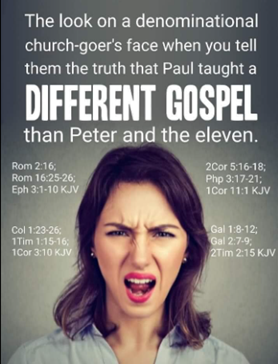
Once again, the claim that Paul taught a different gospel than Peter and other 11 apostles. It’s true. I saw a mem in a Facebook group that not only made the announcement, it provided a long list of passages from the Bible! Here’s the meme:
image

DID Paul preach a “different” gospel than Peter and the other 11 apostles? No fewer than twelve passages of scripture are offered to ‘prove’ that he did. In order to find out if any of those passages actually ‘prove’ the different gospel claim, I copy/pasted all of them into a new document in order to try and find out why they were given as proof texts. Here are the results of my labor:

1. Paul used the term “my gospel” in Rom 2:16 and Rom 16:25-26. Paul was in no way claiming that he ‘owned’ or had a special, unique, or different gospel, but was simply referring to the gospel that he was commissioned to preach.

2. Paul connected himself to the gospel by using terms like “the gospel you heard/received (from me); “the gospel we preached” (Paul and his ministry team); “I (Paul) was made a minister of the gospel. There is no mention whatsoever of the gospel Paul preached being different than the gospel preached by Peter and the 11.

3. Paul mentioned “Gentiles” four times in the ‘proof’ texts. He called Gentiles “fellowheirs” (with Israel) in Eph 3:6 and stated that he was given the primary mission of ministering the gospel to the gentiles three times in the ‘proof’ texts; Eph 3:1 and 3:8, and in Gal 2:8:

Eph 3:6  That the Gentiles should be fellowheirs, and of the same body, and partakers of his promise in Christ by the gospel:

Eph 3:1  For this cause I Paul, the prisoner of Jesus Christ for you Gentiles,

Eph 3:8  Unto me, who am less than the least of all saints, is this grace given, that I should preach among the Gentiles the unsearchable riches of Christ

Gal 2:8  (For he that wrought effectually in Peter to the apostleship of the circumcision, the same was mighty in me toward the Gentiles:

In that entire list of ‘proof’ texts, there is only one passage that talks about the gospel taught by Paul (and his team), as well as the gospel taught by Peter and the 11:

Gal 2:7-10 “But contrariwise, when they saw that the gospel of the uncircumcision was committed unto me, as the gospel of the circumcision was unto Peter; 8(For he that wrought effectually in Peter to the apostleship of the circumcision, the same was mighty in me toward the Gentiles:) 9And when James, Cephas, and John, who seemed to be pillars, perceived the grace that was given unto me, they gave to me and Barnabas the right hands of fellowship; that we should go unto the heathen, and they unto the circumcision. 10Only they would that we should remember the poor; the same which I also was forward to do.”

Not only is there no explicit indication that there were two separate and different gospels (for the circumcised and the uncircumcised), the opposite is true. That’s not just my personal opinion. I consulted no less than seven notable commentaries and all of them agree that while Peter and the 11 were to teach the gospel primarily to a Jewish audience, Paul’s mission was to teach the same gospel primarily to Gentiles (non-Jews). Here are two examples:

“The elder Apostles recognised St. Paul because they saw that his teaching was fundamentally the same as their own. At the same time, the success of St. Paul among the Gentiles proved that his mission to them had the divine sanction, just as the success of St. Peter among the Jews specially marked him out as the “Apostle of the circumcision.” – Ellicott

The gospel of the uncircumcision – The duty of preaching the gospel to the uncircumcised part of the world; that is, to the Gentiles Paul had received this as his unique office when he was converted and called to the ministry (see Acts 9:15; Acts 22:21); and they now perceived that he had been specially intrusted with this office, from the remarkable success which had attended his labors. It is evidently not meant here that Paul was to preach only to the Gentiles and Peter only to the Jews, for Paul often preached in the synagogues of the Jews, and Peter was the first who preached to a Gentile Acts 10; but it is meant that it was the main business of Paul to preach to the Gentiles, or that this was especially entrusted to him.

As the gospel of the circumcision – As the office of preaching the gospel to the Jews.

Was unto Peter – Peter was to preach principally to the circumcised Jews. It is evident that until this time Peter had been principally employed in preaching to the Jews. Paul selects Peter here particularly, doubtless because he was the oldest of the apostles, and in order to show that he was himself regarded as on a level in regard to the apostleship with the most aged and venerable of those who had been called to the apostolic office by the personal ministry of the Lord Jesus.” Barnes

Conclusion? There has always been and will always be ONE gospel. Peter and the 11 had as their primary audience Jews while Paul had as his primary audience non-Jews (Gentiles). Period.

For an old guy like me, that conclusion should be clear to a the average High School English student, assuming they still teach reading comprehension in HS. So why the constant false claim in some circles of professing Christianity?

The answer to that question, in mu my mind anyway, is that we believe what we want to believe. You see, the ‘different’ gospel claim was the product of a form of  Dispensationalism developed in the 19th century that took the took the separation of Israel and the New Testament church taught by some Dispensationalists to illogical extremes. But that’s another story.

How can we respond to the above erroneous claims? Well, like i did for this one, we can examine ‘proof’ texts to see if they actually contain the advertised ‘proof’. We don’t do so with an eye to ‘attack’ the offered proof, but only to examine and perhaps explain the results of our labors, as I have done with this blog. I also offered the results of published here in the FB post containing the meme shown above. Perhaps it will be profitable for readers, but perhaps not.

While I realize that sometimes we need to just walk away from some posts on social media, there are times when someone just might pay attention and grow in their faith walk. All of that’s a personal decision.

BE BLESSED!

Welcome to Babylon!

image

Perhaps one of the most important questions for believers today is this:

“How should Christians relate to this new world where they have lost a home-field advantage and are increasingly marginalized in popular culture?”[i]

This article’s title, Welcome to Babylon! Is also the title of Chapter 1 in Erwin Lutzer’s 2018 book The Church in Babylon. Dr. Lutzer’s chief concern in writing the book was what he termed the death of Christian America:

“What concerns me is the death of Christian America. Many of the biblical values upon which America was founded are no longer being allowed to shape our laws or our lives. In some lesser ways, Christians can identify with the Jews in Babylon. Our culture is instead being shaped by religious fragmentation, widespread disaffection with the church, changing sexual attitudes, and moral and spiritual relativism. Add to that “political correctness” and the “religion” of our political parties run amok, and it’s no wonder America—in the eyes of Christians—looks different each day.”[ii]

What was true in 2018 is perhaps even truer today, in 2024. What Dr. Lutzer described in general terms has various acronyms that have become institutionalized as almost ‘sacred’ in today’s society and culture, and at the same time violates clear Biblical teaching concerning how we as Christians ought to live as salt and light in a dark world. So without getting into the shameful details of we see all around us every day, what can we, as Christians do? How are we to respond to today’s world? Dr. Lutzer suggests that there are at least three ways we could respond, one of which is our only choice:

(1) assimilate the secular culture,

(2) isolate from the secular culture, or

(3) engage the secular culture.

In light of the gospel, the only choice for the Christ follower is to engage.”[iii]

Cultural assimilation would mean the church adopting cultural norms from the world in order to appeal to the world we want to reach. To isolate from the culture in which we live would require separating completely from the world we are trying to reach with the light of the gospel of Christ. The remaining option is to engage the culture, leaving us with the question; “What does it mean to engage the culture?”

To answer that question, we need only examine the instructions God gave, through His prophet Jeremiah, to the Israelites living in Babylonian captivity:

“These are the words of the letter that Jeremiah the prophet sent from Jerusalem to the surviving elders of the exiles, and to the priests, the prophets, and all the people, whom Nebuchadnezzar had taken into exile from Jerusalem to Babylon. 2 This was after King Jeconiah and the queen mother, the eunuchs, the officials of Judah and Jerusalem, the craftsmen, and the metal workers had departed from Jerusalem. 3 The letter was sent by the hand of Elasah the son of Shaphan and Gemariah the son of Hilkiah, whom Zedekiah king of Judah sent to Babylon to Nebuchadnezzar king of Babylon. It said: 4 “Thus says the Lord of hosts, the God of Israel, to all the exiles whom I have sent into exile from Jerusalem to Babylon: 5 Build houses and live in them; plant gardens and eat their produce. 6 Take wives and have sons and daughters; take wives for your sons, and give your daughters in marriage, that they may bear sons and daughters; multiply there, and do not decrease. 7 But seek the welfare of the city where I have sent you into exile, and pray to the Lord on its behalf, for in its welfare you will find your welfare. 8 For thus says the Lord of hosts, the God of Israel: Do not let your prophets and your diviners who are among you deceive you, and do not listen to the dreams that they dream, 9 for it is a lie that they are prophesying to you in my name; I did not send them, declares the Lord.” (Jeremiah 29:1-9, ESV)

After those instructions, is the promise with we are very familiar, and we often claim as our own:

10 “For thus says the Lord: When seventy years are completed for Babylon, I will visit you, and I will fulfill to you my promise and bring you back to this place. 11 For I know the plans I have for you, declares the Lord, plans for welfare and not for evil, to give you a future and a hope. (vv. 10-11)

Do the instructions given to the Israelite captives in Babylon pertain to Christians today? What is God telling Christians who are living as strangers in a strange land today? (1 Peter 2:11-12)

Once again Dr. Lutzer offers us a suggestion:

Let us read every word of this challenge from George MacLeod, a twentieth-century Scottish clergyman, who reminds us where the cross of Christ should be planted. We can’t change the world from a distance: “I simply argue that the Cross be raised again at the centre of the market-place as well as on the steeple of the church. I am recovering the claim that Jesus was not crucified in a cathedral between two candles, but on a cross between two thieves; on the town garbage-heap; at a crossroad so cosmopolitan that they had to write his title in Hebrew and in Latin and in Greek … at the kind of place where cynics talk smut, and thieves curse, and soldiers gamble. Because that is where churchmen should be and what churchmanship should be about.”[iv]

As Christians, we are called to be lights in the darkness:

“Though outnumbered and experiencing the humiliation of being marginalized in our culture, the church is still sent into the world to represent Christ. We are still the best witnesses of hope this hapless planet has! We, as the church, will never be effective unless we see ourselves as sent by Christ into the world. He prayed, “As you [the Father] sent me into the world, so I have sent them into the world” (John 17: 18). We are pilgrims, out of step with the ever-changing culture—yet we are sent by Christ, the Head of the church. The church is the last barrier between the present moral breakdown and total chaos.”[v]

A final question. If the church is the last barrier between the present moral breakdown and total chaos, how do we shine as lights in the darkness and make a difference for the Kingdom of light? Two ways come immediately to mind as starting points.

First, just at the Israelites were commanded to do in 6th century Babylon, we are to live normal lives in today’s Babylon, but not in service to the gods of this world. We are to seek to glorify God in all that we do. (Matthew 5:16)

Secondly, we must be prepared to share with others the hope that we have in Jesus Christ:

“But in your hearts honor Christ the Lord as holy, always being prepared to make a defense to anyone who asks you for a reason for the hope that is in you; yet do it with gentleness and respect, having a good conscience, so that, when you are slandered, those who revile your good behavior in Christ may be put to shame. (1 Peter 3:15-16, ESV).


[i] The Church in Babylon: Heeding the Call to Be a Light in the Darkness by Erwin W. Lutzer. p 11.

[ii] Ibid, p 52

[iii] Ibid, p 12

[iv] Ibid, p 73-74

[v] Ibid, p 58

__________________________

Dr. Erwin W. Lutzer (born October 3, 1941) is an evangelical Christian speaker, radio broadcaster, and author. He is the pastor emeritus of The Moody Church in Chicago, Illinois. His book The Church in Babylon: Heeding the Call to Be a Light in the Darkness can be obtained from Amazon.com , as well as from other Christian book outlets.

Glimpsing the Gospel in Every Book of the Bible

image

Biblical literacy is ever important for Christians as we seek to understand how the Scriptures come together to tell the story of the gospel.

This is the one of a series of short summaries of books of the Bible (Genesis and Exodus to) to help place their content into the larger story of the Bible as a whole.

Genesis

Many readers miss the forest of God’s larger purposes when immersed in the trees of each individual story. In creation, God creates humanity in his own image as his representatives to fill and rule the earth on his behalf (Gen. 1:26–28). Even after Adam and Eve sin and are punished, the promise is given that the offspring of the woman will defeat the serpent and restore the earth (Gen. 3:15). This promise is traced throughout the book in its genealogies,3 which provide the backbone of the entire book. Key divisions are traced by “These are the generations of,” tracing out the stories of key figures, starting with “the heavens and the earth” (2:4–4:26), and going on to Adam (5:1–6:8), Noah (6:9–9:29), the sons of Noah (10:1–11:19), Shem (11:10–26), Terah (11:27–25:11), Ishmael (25:12–18), Isaac (25:19–35:29), Esau (36:1–37:1), and Jacob (37:2–50:26). The line of God’s blessing is emphasized (e.g., Adam, Noah, Terah, Isaac, Jacob), while the stories of other lines receive less attention (e.g., Ishmael, Esau). The individual stories of Abraham, Jacob and Joseph are illustrations of how the promise of Genesis 3:15 begins to be fulfilled.

God desires to bless the nations through a future king. Adam is portrayed in the image of God, a phrase probably signifying a royal representative of God. Abraham would become a “great nation” (Gen. 12:2), and “kings shall come from you” (Gen. 17:6). God’s original command to “Be fruitful and multiply and fill the earth” (Gen. 1:28) is fulfilled in microcosm4 as “Israel settled in the land of Egypt . . . and were fruitful and multiplied greatly” (Gen. 47:27; cf. 1:28).

Israel fails, however, in its calling to be a “kingdom of priests” (Ex. 19:6). This priesthood is ultimately fulfilled through the church in Jesus Christ as a “royal priesthood” of all nations (1 Pet. 2:9). Through this priesthood, God’s purposes for creation as detailed in Genesis 1–2 are finally accomplished, as is seen in Revelation 21–22.

Exodus

Whereas Genesis records God’s promise that Abraham would become a great nation (Gen. 12:2), Exodus describes the fulfillment of that promise (Ex. 1:6– 7). Moreover, God’s covenant with the patriarchs,3 in which he promised to give their descendants the land of Canaan (Gen. 15:18; 26:3; 35:12), is the reason God delivers Israel from Egypt (Ex. 2:24).

Although God gives Israel the law and comes to dwell in their midst, ultimately Israel will not be faithful to their covenant with him. Only in Jesus do we find a faithful Israelite who keeps God’s law while simultaneously embodying God’s presence with his people (John 1:14).

_____________________________________

Taken from Glimpsing the Gospel in Every Book of the Bible by Crossway ©, October 19, 2018. Used by permission of Crossway, a publishing ministry of Good News Publishers, Wheaton, IL 60187, www.crossway.org.

Here’s a link the the Crossway .org site that lets you browse through the same short summary for every book of the Bible: Glimpsing the Gospel in Every Book of the Bible | Crossway Articles

BE BLESSED!

That America may bless the world: Jamestown settlers

Reverend Robert Hunt, Cape Henry

“We do hereby dedicate this Land, and ourselves, to reach the People within these shores with the Gospel of Jesus Christ, and to raise up Godly generations after us, and with these generations take the Kingdom of God to all the earth. May this Covenant of Dedication remain to all generations, as long as this earth remains, and may this Land, along with England, be Evangelist to the World. May all who see this Cross, remember what we have done here, and may those who come here to inhabit join us in this Covenant and in this most noble work that the Holy Scriptures may be fulfilled.”

Using covenantal language, Hunt declared, “from these very shores the Gospel shall go forth not only to this New World but the entire world.” The following Bible passage was read at the conclusion of the prayer: “All the ends of the world shall remember and turn to the Lord, and all the kindreds of the nations shall worship before thee. For the kingdom is the Lord’s and he ruleth among the nations” (Ps. 22:27–28).

The Jamestown settlers believed in a covenantal approach to history whereby future generations would “take the Kingdom of God to all the earth”—and this is the important part—“as long as this earth remains.” These concepts came directly from the notes of the Geneva Bible with its kingdom-advancing approach!

The Apostle Paul, a Veiled Gospel, and Blind Minds

2 Corinthians 4:1-6

The Light of the Gospel

“Therefore, having this ministry by the mercy of God, we do not lose heart. But we have renounced disgraceful, underhanded ways. We refuse to practice cunning or to tamper with God’s word, but by the open statement of the truth we would commend ourselves to everyone’s conscience in the sight of God. And even if our gospel is veiled, it is veiled to those who are perishing. In their case the god of this world has blinded the minds of the unbelievers, to keep them from seeing the light of the gospel of the glory of Christ, who is the image of God.” (1 Cor 4:1-4, ESV)

Paul’s letters to the church at Corinth were meant to deal with specific issues facing the young church. His first letter dealt with destructive divisions in the church, along with issues of immorality and carnality in the church. His second letter dealt, at least in part with having to answer the criticisms of false teachers who openly opposed him. In the short passage above Paul speaks of three things, his ministry, the gospel he preached being veiled (hidden) from some hearers, and ‘blind’ minds incapable of understanding the gospel.

We will briefly discuss each of these, in the order presented, with an eye to their application to personal evangelism.

The Apostle Paul

“But we have renounced disgraceful, underhanded ways. We refuse to practice cunning or to tamper with God’s word, but by the open statement of the truth we would commend ourselves to everyone’s conscience in the sight of God.” (2 Cor 4:2)

In this verse Paul renounces of disgraceful underhanded ways, asserts his refusal to practice cunning or to tamper with God’s word in presenting the gospel, and reaffirms his intent to merely speak the plain truth of the gospel. Paul’s message to this church, as well as to the others he planted was simple – “Christ and him crucified” for the sins of men. (1 Cor 2:1-4) No slick marketing campaigns, house to house surveys, or twisting of scripture in order to please itching ears.

A Veiled Gospel

“And even if our gospel is veiled, it is veiled to those who are perishing.” (2 Cor 4:3)

Here Paul, at his hypothetical best, tells us that if the message of the gospel is “veiled”, or hidden from anyone it would be those are who are “perishing” in their sin, Jesus referred to these unbelievers as “condemned already”. (John 3:18). Nowhere does Paul ever tell us not to preach the gospel, but he does tell us that the gospel we preach very likely won’t be understood by some of our listeners. Talk about a tough job! There’s an answer to that problem, and we’ll get to it.

Blind Minds

“In their case the god of this world has blinded the minds of the unbelievers, to keep them from seeing the light of the gospel of the glory of Christ, who is the image of God.” (2 Cor 4:4)

Here Paul tells us exactly WHY unbelievers cannot understand the gospel message. Their minds have been completely blinded to the spiritual truths underlying the message! Not only that, we are told that the one who has blinded the minds of unbelievers is “the god of this world”, or Satan himself! In John 12:31, he is called “the prince of this world.” In Ephesians 2:2, he is called “the prince of the power of the air.” And in Ephesians 6:12, the same bad influence is referred to under the names of “principalities, and powers,” “the rulers of the darkness of this world,” and “spiritual wickedness in high places.”

So what?

How should that impact personal evangelism?

1. Stick to the message – stay on point. And the whole point of the gospel message is that Christ died for the sins of men. Don’t sugar coat it. The gospel is a bad news/good news story. Present the problem (sin) followed by the solution (Jesus Christ).

2. Realize that there are those from whom the good news is veiled, or completely hidden. They cannot even understand it (1 Corinthians 2:14). Trust God to open hearts to hear it, understand it, and receive it.

3. Recognize that it is Satan who has blinded the minds of everyone who has yet to believe in Christ. We would probably equate having a ‘blind mind’ with a complete inability to process information. By all means use kind and persuasive speech as you share an ‘offensive’ truth, but let God open cold and spiritually dead hearts to hear and be saved.

Good Friday – The Rest of the Story

Today Christians remember the day that their Savior died on a cross at Mount Calvary, finishing the work that He was sent here to accomplish – to die for and save His people from their sins (Matthew 1:21). Three days later, Christ rose from the dead, leaving an empty tomb, displaying the power and glory of God, both in Christ’s resurrection and foreshadowing the raising of spiritually dead sinners to new life in Christ.

Just a few comments – food for thought about what it all means:

John 3:16 – 19

16“For God so loved the world, that he gave his only Son, that whoever believes in him should not perish but have eternal life. 17 For God did not send his Son into the world to condemn the world, but in order that the world might be saved through him. 18Whoever believes in him is not condemned, but whoever does not believe is condemned already, because he has not believed in the name of the only Son of God. 19And this is the judgment: the light has come into the world, and people loved the darkness rather than the light because their works were evil.”

Let’s break that down, beginning with the most memorized passage in all of the New Testament.

16“For God so loved the world, that he gave his only Son, that whoever believes in him should not perish but have eternal life.

This verse tells us that those who believe in The Son will have eternal life. What are we to believe about the Son? In Mark 1:15 Jesus told his listeners to “..repent and believe the gospel.” The Apostle Paul defines the gospel quite clearly in 1 Corinthians15:1-4:

1“Now I would remind you, brothers, of the gospel I preached to you, which you received, in which you stand, 2and by which you are being saved, if you hold fast to the word I preached to you—unless you believed in vain. 3For I delivered to you as of first importance what I also received: that Christ died for our sins in accordance with the Scriptures, 4that he was buried, that he was raised on the third day in accordance with the Scriptures

17 For God did not send his Son into the world to condemn the world, but in order that the world might be saved through him.”

The Son’s first coming into this world was to save sinners who repent and believe the gospel. His second coming will be as the righteous judge of the whole world. (Matthew 24:30; Revelation 19)

18Whoever believes in him is not condemned, but whoever does not believe is condemned already, because he has not believed in the name of the only Son of God.

This verse tells us that those who have repented of their sin and believed the gospel are not now condemned, nor will they be condemned at the judgment. It also tells us that those who have not repented of their sins and believed in the Son stand condemned already, even as they live and breathe.

19And this is the judgment: the light has come into the world, and people loved the darkness rather than the light because their works were evil.”

This verse tells us WHY so many have not repented of their sin and believed in the Son. They love the darkness in which they live, in which we all once lived. They love the darkness BECAUSE their deeds are evil. Would it be a stretch to say that they LOVE their sin, or would it be a strikingly logical conclusion?

The really BIG question is, “Have you repented of your sin and believed the gospel?” Are you safe in the arms of Christ, or do you stand ‘condemned already’ before a just and holy God?

Those are questions between you and God. Do not take them lightly. Don’t answer me, answer Him.

Sharing Christ in a Hostile Culture, Pt 3– Our Duty, Our Great Privilege, and Our Highest Calling

In Part 1 of this series of articles, Be Available, we shared real examples of how doors seem to just ‘open up’ for sharing the message of the gospel, and what can happen when there’s a willing and available gospel messenger ‘on location’.

In Part 2, Situational Awareness, we compared our ‘Situation’ as believers in Christ – our status, and true citizenship, with our condition (situation) before repenting of sin and believing Christ.

This article focuses on understanding the nature of the believer’s role in sharing Christ with the world around us. Bear in mind that God, being GOD, is able to save lost sinners in any way He chooses to do so, with, or without our involvement. At the same time, it’s important to remember that God has not only provided for the salvation of His people (through Christ); he has chosen the means by which he saves lost sinners. – the preaching of the gospel (sharing Christ). This means that fur you and me (and all believers) sharing Christ with a lost world is at least three things; Our Duty, Our Great Privilege, and Our Hignest Calling!

Our Duty

18And Jesus came and said to them (the disciples), “All authority in heaven and on earth has been given to me. 19Go therefore and make disciples of all nations, baptizing them in the name of the Father and of the Son and of the Holy Spirit, 20teaching them to observe all that I have commanded you. And behold, I am with you always, to the end of the age.” (Mathew 28:18-20)

You might be thinking that there is no command for personal evangelism in the above passage of scripture, I beg to differ. Jesus’ command, to ‘make disciples’, by its very nature requires sharing the message of the gospel. Disciples are only produced from saved; blood bought sinners. Jesus disciples (followers) were commanded to make disciples of those were already believers and preach the message of the gospel to those still lost so that they could then be made into disciples.

Our Great Privilege

God not only provided the way of salvation of His people in the death and resurrection of His Son, He also decreed the means whereby men are saved.

13“For ‘everyone who calls on the name of the Lord will be saved.’ 14How then will they call on him in whom they have not believed? And how are they to believe in him of whom they have never heard? And how are they to hear without someone preaching? 15And how are they to preach unless they are sent? As it is written, “How beautiful are the feet of those who preach the good news!” (Romans 10:13-15)

The above passage is crystal clear. Those who call on the Lord will be saved. Calling on the Lord means believing in Him. To believe they must first hear the good news (evangel). For them to hear, someone must preach Christ to them. Those who share the good news are ‘sent’ by God to do so.

Dear friends, WE ae among those who are sent to share the good news! The Great Commission was given specifically to Jesus’ immediate disciple, but it was meant for all believers for all time.

God has chosen to use flawed you and me to share His perfect message of salvation! How is that NOT the greatest privilege bestowed on God’s children?

Our Highest Calling

I recently read an article in a local newspaper about an F/A-18 Super Hornet weapons system officer who was actually the first female pilot to bomb ISIS from an F/A 18. Here is how she described ISIS and her role in the bombing:

“They are a horrible crop of humans, with an utter disregard for human life,” she said. “To witness that, day in and out, to witness mass murder, you have such an understanding. I’d trained for so long to protect innocent people on the ground, and when I saw that violated, and to finally use my skills to do that and use weapons, there is no higher calling.” (Emphasis mine)

With no disrespect to either a fine Naval officer or anyone who fights global terrorism, I have to confess that the immediate reaction of this old soldier was “But there IS a higher calling!” – to share the gospel of Jesus Christ with the world around us, and often hostile culture in which we live.

In many churches these days much is made of living our best lives now, discovering our special purpose for our time on planet Earth, and even achieving our ‘dream destinies’. Friends, I suggest to you that all of those things are merely temporary at best. I also suggest to you that our duty and great privilege to share the good news of Jesus Christ with a lost world, and the eternal consequences at stake (heaven and hell), define the great commission as the highest calling a blood bought child of God has received from heaven!

Be blessed!


Sharing Christ in a Hostile Culture Part 2 – Situational Awareness

I find it interesting that the first paragraph of military combat orders cover the battlefield “Situation”, followed by “Mission”. Many of us might think that a statement of the missions would come first.   ‘Situational Awareness’ (SA), a term familiar to many of us, means nothing more than recognizing your circumstances; knowing what’s going on around you. For instance, a military commander must be aware of the total situation (enemy and friendly) around him and his unit on the battlefield, as well as the bigger ‘strategic’ picture.  Total situational awareness is essential for successful military operations against any enemy, on any battlefield, for any warrior.  As Christians, and warriors in the Kingdom of God, we need to maintain complete situational awareness as inhabitants of planet earth (the battlefield environment), as well as our Commander’s intent (God’s strategic picture).

Sadly, we often lose focus of both our battlefield environment and our Commander’s intent, for a variety of reasons, ranging from our tendency to focus almost exclusively on ‘personal’ growth and fulfillment, to applying human wisdom and worldly principles to the operation of the ‘postmodern’ church as a whole.  At both levels, the result is that the Lord of the harvest, the Holy Spirit, sits in the back of the bus as we arrogantly occupy the driver’s seat!

Dear readers and friends, it is past time to regain our ‘situational awareness’ and overcome our spiritual ‘nearsightedness.’  For that task, we need to ‘begin at the beginning’ of our lives as Christians and go from there.  In a familiar and often quoted verse of Scripture, the Apostle Paul tells us:

“Therefore, if anyone is in Christ, he is a new creation; the old has gone, the new has come!” 2 Corinthians 5:17

What a promise – the greatest makeover of all time!  When we place saving faith in Christ, we step out of darkness and into the light, passing from death to life!  We are given a new nature in Christ as the Holy Spirit takes up residence in our being, giving us a desire to serve God and the power to live a life of obedience to Him. This is common knowledge, not rocket science.

Our ‘makeover’ is so complete that in another of his letters to the early church, Paul presents what is a mystery to limited human logic.

“And God raised us up with Christ and seated us with him in the heavenly realms in Christ Jesus,” Ephesians 2:6 

This is a bit more difficult for human logic to grasp, but notice the past tense verbs in this verse. Paul is saying that as Christians, although we physically remain here on planet Earth, we have already been ‘raised up’ and ‘seated with Christ in the heavenly realms.’  Paul partially explains this mystery in more easily understood terms a bit later in the same chapter:

“Consequently, you are no longer foreigners and aliens, but fellow citizens with God’s people and members of God’s household. . .” Ephesians 2:19

A citizen is a legal resident of a nation, country or state.  Paul is saying that, at the moment of salvation, our ‘legal citizenship’ status changed!  One could say that if before we received Christ, we could have visited the ‘heavenly realm,’ we would have been ‘illegal aliens.’  We are not like the child born to an American military family overseas, who has dual-citizenship status until he or she is 18 years old and needs to make a decision.  We are NOT dual citizens.  Now listen to the Apostle Peter in one of his letters to the early church:

“Dear friends, I urge you, as aliens and strangers in the world, to abstain from sinful desires, which war against your soul.” 1 Peter 2:11 

Do you see the contrast here? Paul tells us that at one time we were ‘aliens and foreigners’ to God’s household, while Peter tells us that as Christians we are now ‘aliens and strangers’ in the world in which we live!

Why is the world in which we live ‘foreign territory,’ why are we ‘aliens and strangers in it,’ and how do we apply these truths?

First, we need to understand that the world in which we live is not, the world that God created and pronounced ‘good’ and ’very good’.  In fact, Scripture tells us that the willful disobedience of Adam and Eve in the Garden of Eden affected more than just our little piece of turf.  There is a clear description of the present condition of God’s creation in Romans 8:17-24, in which we find the following:

“We know that the whole creation has been groaning as in the pains of childbirth right up to the present time.” Romans 8:22

All of God’s creation is somehow tainted, polluted by sin, and in need of redemption.

Scripture also gives us an interesting description of the state of the human race after the fall of Adam, as well as a who seems to be controlling things (the god of this world).

“As for you, you were dead in your transgressions and sins, in which you used to live when you followed the ways of this world and of the ruler of the kingdom of the air, the spirit who is now at work in those who are disobedient.” Ephesians 2:1-2

“The god of this age has blinded the minds of unbelievers, so that they cannot see the light of the gospel of the glory of Christ, who is the image of God.” 2 Corinthians 4:4

As believers, we are citizens of the household of God, with a new ‘landlord,’ servants of the Most High God, no longer bound by the god of this world.  And as members of God’s household, we are now foreigners and strangers to the world we live in and enemies of the ‘god of this world.’

If you still aren’t convinced of your citizenship as a Christian, listen to the words of Jesus from his high priestly prayer:

“I am coming to you now, but I say these things while I am still in the world, so that they may have the full measure of my joy within them. I have given them your word and the world has hated them, for they are not of the world any more than I am of the world. My prayer is not that you take them out of the world but that you protect them from the evil one. They are not of the world, even as I am not of it. Sanctify them by the truth; your word is truth. As you sent me into the world, I have sent them into the world. (John 17:13-16)

I have come to the inescapable conclusion that we are living behind enemy lines!  Perhaps this has caused your thought process to pause for a moment of speculation.  Maybe it came to a screeching halt because your first reaction was “No way!”  Then hear what the Apostle James had to say to believers in his day who were becoming a bit too ‘friendly’ with the fallen culture around them.

“You adulterous people, don’t you know that friendship with the world is hatred toward God? Anyone who chooses to be a friend of the world becomes an enemy of God.” James 4:4

If you still aren’t convinced that we are living in enemy territory, I encourage you to read James 4 in its entirety, followed by Jesus’ words to his followers in John, chapters 15 and 16, concerning what to expect from the world that is hostile to God.

All of the above leaves with an inescapable question: “Why are we still down here?”  That might be connected to the second paragraph of a Combat Order – “Mission”. More to follow.

The Holy Spirit in Evangelism and the Salvation of Sinners

Evangelism

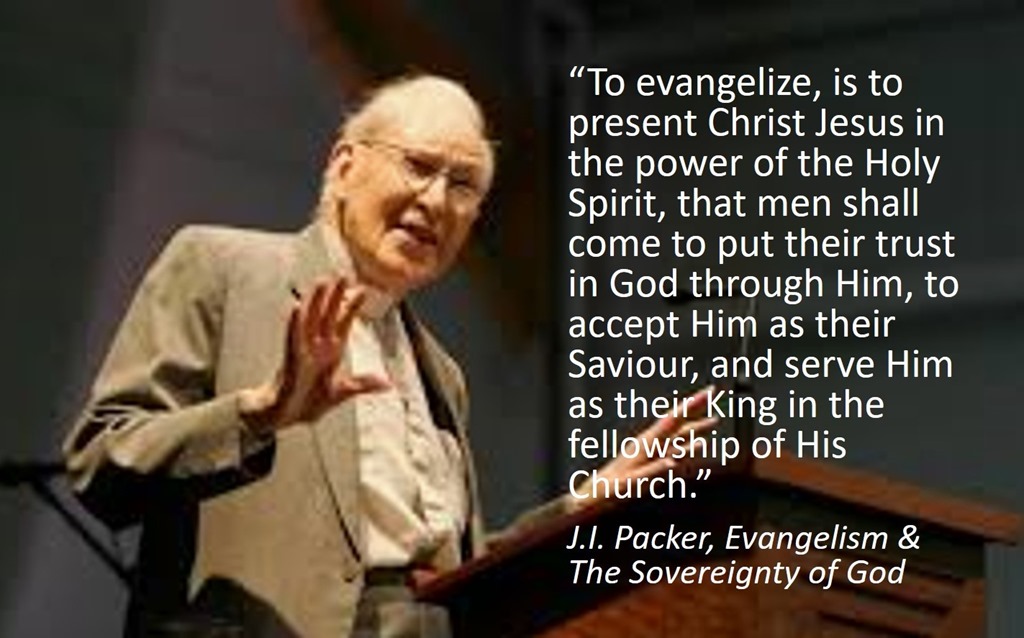
In the above quotation from J.I. Packer’s book, Evangelism and the Sovereignty of God. we can see the work of the Holy Spirit in at least there ways.

1.  The Holy Spirit Empowers the evangelist.  While it is true that the message of the Gospel can be presented as if it’s a matter of mere facts, or an intellectual exercise, the sharing of the Gospel message In the power of the Holy Spirit carries with it  certain Divine authority that is not lost on the hearer.

2.  The Holy Spirit opens the heart of the hearer to receive the Gospel message. While it is also true that the Gospel message can be heard by anyone at all, a God-opened heart guarantees that it will be taken to heart, received with gladness, and a lost soul saved for eternity. No better example can be found than the woman Lydia in the 16th Chapter of the book of Acts.

3.  The Holy Spirit no only empowers the evangelist and opens the heart of the sinner, He also empowers the new born believer to live for God and serve Him from that day forward.. It is the Holy Spirit that works in the Christian both to desire and to do what is pleasing to his Lord. (Phil 2:13).

Food for thought………….

If you are interested in a review of, or obtaining Evangelism and the Sovereignty of God, go here for either or  both.