Does God Hate Sinners?

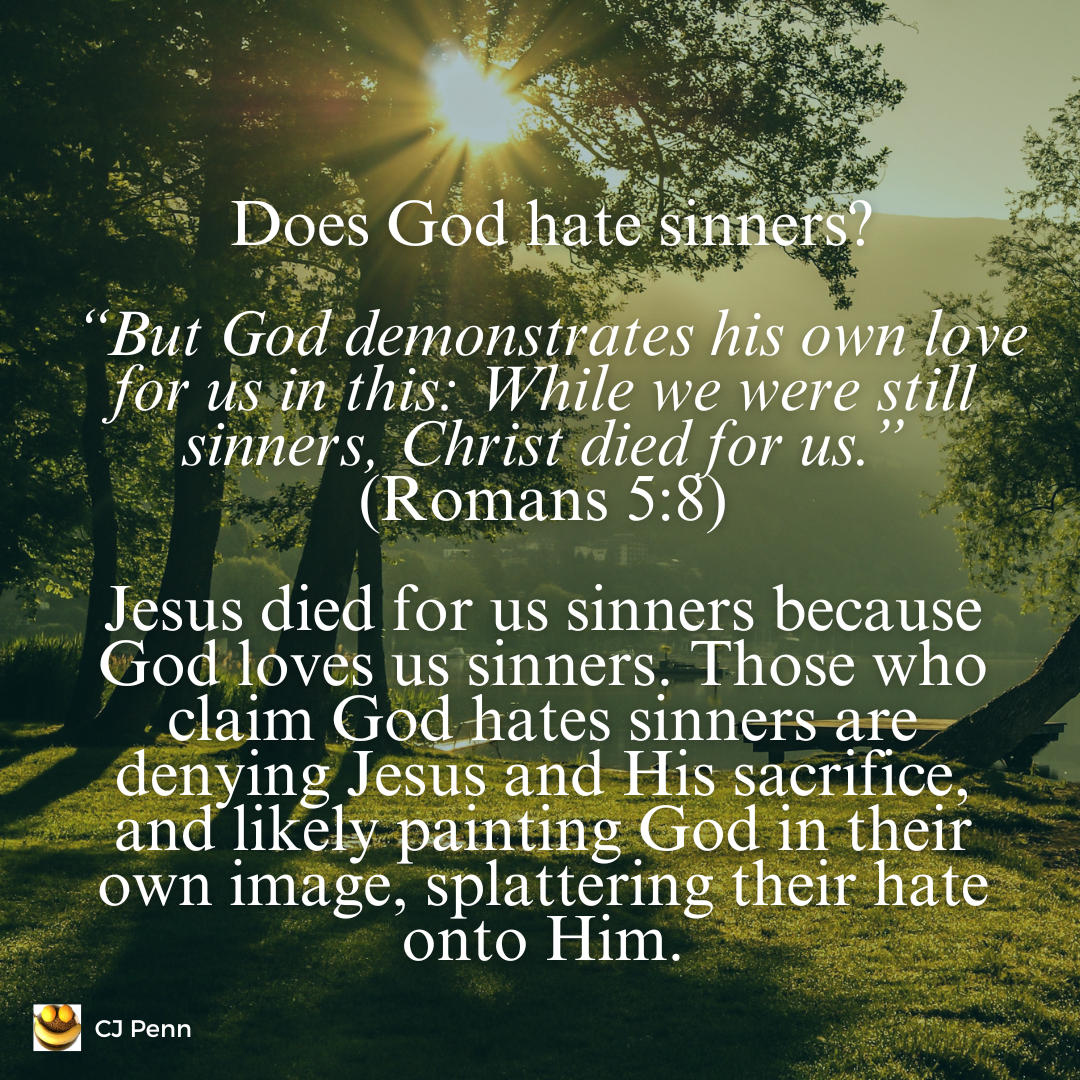
Does God hate sinners

That’s a meme I found in a Facebook Group recently that caused me to reconsider God’s love, as well as God’s hate. We love to dwell on God’s love, and rightly so! We don’t often dwell on what God hates. We are told to “Love the sinner but hate the sin.”, although it’s not actually a verse found in the Bible. I was curious about the comment, “Those who claim God hates sinners are denying Jesus and His sacrifice, and likely painting God in their own image and splattering their hate onto Him.” (Psychologists call that ‘projection’- the process of displacing one’s feelings onto a different person, animal, or object.)

So, wanting to find out more about what the author had in mind, I replied very simply, “Proverbs 6:16-19?”

Proverbs 6:16-19:

16These six things the Lord hates,
Yes, seven are an abomination to Him:
17 A proud look, A lying tongue,
Hands that shed innocent blood,
18 A heart that devises wicked plans,
Feet that are swift in running to evil,
19 A false witness who speaks lies,
And one who sows discord among brethren.

I received as a response: “Please also consider Luke 6:27-28. Would Jesus expect us to love our enemies, yet not love His own enemies, (e.g., sinners)?” That was an honest reply, although it didn’t address the Proverbs passage that indicates that God does in fact hate some people.

Luke 6:27-28

27 “But I say to you who hear: Love your enemies, do good to those who hate you, 28 bless those who curse you, and pray for those who spitefully use you.

We are told that there are things that God hates in the Proverbs passage and how we are to treat our enemies in the Luke passage. These are different contexts.

“It might seem a contradiction that a God who is love can also hate. Yet that’s exactly what Bible says is true: God is love (1 John 4:8), and God hates (Hosea 9:15). God’s nature is love—He always does what is best for others—and He hates what is contrary to His nature—He hates what is contrary to love.”[i]

Psalm 5:4-6 tells us specifically that God hates wickedness and individuals:

4For You are not a God who takes pleasure in wickedness,
Nor shall evil dwell with You.
5 The boastful shall not stand in Your sight;
You hate all workers of iniquity.
6 You shall destroy those who speak falsehood;
The Lord abhors the bloodthirsty and deceitful man.

Is there some kind of contradiction there? No. Scripture never contradicts itself.

What should we do with all of this? Well, God is God and cannot do evil. If that’s true, God’s hatred for whatever or whomever He hates is pure and just at the same time.

In the Romans 5 passage, Paul is telling ‘believers’ in Rome that while “we” were yet sinners Christ died for us. What does that mean? We are all born in rebellion against and enemies of God (Rom 8:7-8) Does it point to what the Bible calls the “elect” of God? Those who were “ordained to eternal life” (Acts 13:48). Does God love His “elect” (chosen before the foundation of the world for salvation (Eph 1:4 & 2 Thess 2:13) with a special love that is different than His love for the rest of His creation?

These are just questions that I have wrestled with and am still working on. What do I KNOW? That I am not God. That I am to love my enemies for the sake of Christ, whose sole mission was to come to this earth to “save His people from their sins” (Matt 1:21).

I KNOW that in sharing the gospel with the world around me, I’m to be like the farmer who plants seed and then goes to bed, to rise again the next day and plant more seed, not knowing exactly how it grows (Mark 4:26-29. I am to share the gospel to God opened hearts (Acts 16) and trust Him to save those whose hearts he opened to ‘hear the gospel’. So I pray often for God to open hearts to ‘Hear’ the message and thank Him that I have the great privilege of sharing that message.

BE BLESSED!


[i] Does God hate? If God is love, how can He hate? | GotQuestions.org

Have you “stretched yourself out on Jesus”?

In a sermon called “The Gospel of Christ”, from Romans 1:16-17, Dr. John MacArthur tells the following story about a Scottish missionary:

clip_image002“One of my favorite missionaries is John G. Paton.  He went to the New Hebrides filled with cannibals.  And when he arrived in the New Hebrides, he came to an island at the moment when there was a terrible epidemic.  People were dying of disease.  It had utterly decimated the population.  He went into the huts of the sick people and tried to care for them.  He buried the dead.  He tended to the dying.  And when the epidemic had passed, he was received by all, and they loved him, and he stayed with them.

He first thought to learn their language.  And he began to listen to their speech, write down in a notebook all the words and phrases he learned.  The natives got accustomed to him always having a notebook and stopping in the middle of the conversation to write some things down.  There came a time, then, when he decided that he ought to translate some of the gospel into their language.  But they had no word in their vocabulary for “faith” or “trust” or “believe.”  They just didn’t trust anybody.  But you can’t do much translating in the Bible without a word for that.  And so he began to think.

At a time of frustration, he began to go deer hunting.  And they shot a deer-like animal and several smaller game and started to carry the kill back to the house of the missionary.  The weather was at the equatorial point in the globe, oppressive. The hill in which they hunted was trackless, and they finally arrived back absolutely exhausted.  They dropped their heavy burden and all of them just flopped on the grass.

One native said, “Oh, it’s good to stretch yourself out here in the shade.”  John Paton shot off that grass, excitedly he had that companion recite that sentence again and again.  And he wrote it all down in his notebook.  And then he translated John 3:16 this way, “For God so loved the world that He gave His only begotten Son, that whosoever stretcheth himself out on Him shall not perish but have everlasting life.” That’s faith, and it activates the righteousness of God in your behalf.”

Several things stood out to me, along with questions I need to ask myself, when I listened to the MacArthur sermon that included this marvelous story.

  • John G. Paton left his home in Scotland to take the gospel of Jesus Christ to tribes of cannibals in the South Pacific. He loved the natives of the New Hebrides, so much so that he remained with them after caring for them and even burying those who died during a terrible plague. How does my concern for the lost around me, especially family, friends, co-workers and acquaintances compare with John Paton’s love for South Sea cannibals?
  • He prioritized learning their language, so much so that he carried around a little notebook in which to write new words and phrases he was learning. If you have ever been the student of a foreign language, I’m sure you understand the value of writing down new words and phrases. I once knew a native-born Polish instructor whose daughter was forever learning new languages, writing down words and phrases on sticky notes and posting them all over the house.
  • He also realized what having portions of the gospel message in their own language could mean to his new friends. If you know anything about the Wycliffe Bible Translators, you probably know that they have translated the Bible into foreign languages in the same manner John Paton did, searching for words and phrases in native languages that carry the clear meaning of familiar English passages.
  • I can only imagine what it must have been like to see the hot and tired hunters dropping their heavy burdens on the ground and “stretching out in the shade”! Every soldier who has trudged through the hot sun with an Then there was the “Eureka!” moment that John experienced when he suddenly realized that had just heard the perfect definition of “faith” needed to translate John 3:16 into the native language of his new friends!

“For God so loved the world that He gave His only begotten Son, that whosoever stretcheth himself out on Him shall not perish but have everlasting life.”

I am reminded that the great burden for those who have yet to “stretch themselves out on Christ” is the weight of the sin to which they are enslaved (John 8:34; Rom 6:17). Unlike the tired native hunters who found shade where they could drop their heavy loads and rest, everyone who has yet to embrace Christ loves darkness rather than light (John 3:19).

If I am to be a light in the darkness and lead others to Christ, it is therefore necessary that I help those living in, and loving their darkness recognize that sin is that issue that the message of the gospel addresses and not the myriad other issues that we sometimes present as reasons to receive Christ.

So how do I do that? How can I get someone I care for to realize that the things he/she loves is a great burden leading to an eternity of pain and torment? Well, I can’t, but God can. I can ask Him to open hearts to receive the gospel message and then share it faithfully (see Acts 16 and the story of Lydia), remembering the words of the Apostle Paul.

“For I am not ashamed of the gospel, for it is the power of God for salvation to everyone who believes, to the Jew first and also to the Greek.” (Rom 1:16)

1Now I would remind you, brothers, of the gospel I preached to you, which you received, in which you stand, 2and by which you are being saved, if you hold fast to the word I preached to you—unless you believed in vain. 3For I delivered to you as of first importance what I also received: that Christ died for our sins in accordance with the Scriptures, 4that he was buried, that he was raised on the third day in accordance with the Scriptures.” (1 Cor 15:1-4, ESV)

__________________________________________________________________________

If you want to find out more about John G. Paton, you can find numerous articles online, one of which is located at Ligonier Ministries: Who Was John G. Paton? (ligonier.org).

Before You Share Your Faith–Book Review

image“Before You Share Your Faith: Five Ways to Be Evangelism Ready by pastor Matt Smethurst offers five foundational recommendations to help you talk to others about Jesus with confidence.[i]

In his preface to the book’s contents, the author, (Matt Smethurst) says this:

“This is not a handbook of evangelistic jujitsu tips. I’ll leave that to more able voices. This volume is about getting ready to open your mouth at all. It’s about preparation for the conversation.”

The book then devotes a chapter to each of the author’s five recommendations to help you talk to others about Jesus.

1. Grasp the Gospel

To assist us in grasping the message of the Gospel, we can look at it with a “wide lens” and a “zoom lens”; in four “movements”: the Ruler, the Revolt, the Rescue, and the Response. (I love alliteration!) A bit of alliterative assistance combined with an easily understood description of each “movement” makes it hard NOT to remember the elements of the gospel message!

2. Check Your Context

Checking our context involves knowing our audience, being able to break down the gospel message to make it clear, and understanding what’s at stake, and excelling at asking questions.

3. Love the Lost

Loving the lost involves being a friend and is often referred to as “friendship” or “relational ” evangelism. In the words of the author, “The Bible never says that speaking the truth IS love, but it says we are to speak the truth IN love. Ponder that distinction – it I subtle but critical.

4. Face Your Fear

Fear, apprehension, and nervousness, at some level always seem to haunt us. On the other hand, evangelism is not complicated: if we wait until our fears have completely evaporated, we might never share it. Don’t wait for the perfect scenario because it might never come. Instead resolve to seize the opportunities God presents to you.

5. Start to Speak

“Preach the gospel at all times; if necessary, use words.” Catchy phrase, isn’t it? Sad to say, it’s not biblical. Communicating the good news about Jesus Christ always requires words. Above all, pray. Pray before the first conversation, pray during the conversation, pray after the conversation. Pray singly and corporately. Pray that God will open hearts to receive the message (like Lydia in Acts 16). Be faithful to the gospel message. Remember that God saves sinners, we don’t.

A final thought from Matt Smethurst:

“Some if my richest gospel conversations over the years have not been planned. . . by me. But God had other plans.”

Before You Share Your Faith contains much more than this brief review could provide. It can be ordered from Truth for Life Store  at the link below, as well as from other book sellers.

________________

[i] Books and Booklets – Store – Truth For Life

For the Times They are A-changin’ – Bob Dylan

Bob Dylan was right in 1964, when he wrote that song, and he’s still right. In fact, the times are always changing, for better or worse. In 2021, we live in an especially ‘interesting’ time of change in our nation. It seems that academia (all levels), modern culture, and institutions are wholeheartedly embracing ideologies and policies contrary to their essential purposes in providing goods, services, and entertainment. Some of these ideologies and policies are contrary to a Christian worldview and blatantly oppose Divine moral law and support that which God terms “abomination”. Those who stand against the tide are losing friends, their reputations, their livelihoods, and much more. We live in what’s called a “cancel culture.” I’m certain, that if it were possible, those who try to “cancel” everything and everyone opposing them would also try and cancel God.

Furthermore, every facet and level of our society is being impacted by the ever-increasing moral decay and lawlessness we see all around us. Legislation, rules, regulations, and policies have been written to ‘engourage’ us to ‘behave’. Unbelievers and nonconformists will be persecuted and/or punished! That includes everyone, no matter what their function in society, their religious persuasion, their age, and anything else you can think of.

How do we, as Christians, respond to our ‘anti-God’ culture? That’s our challenge.

On one hand, there’s nothing new under the sun. The world’s operating system has always been at odds with Christianity and Christians have always been under pressure to conform to the world’s ungodly standards. Jesus even told his closest followers:

“If the world hates you, keep in mind that it hated me first. If you belonged to the world, it would love you as its own. As it is, you do not belong to the world, but I have chosen you out of the world. That is why the world hates you.” (John 15:18-19)

What appears to be a rather recent development however, is the speed and manner in which we are being brought into submission to what seems like a “new world order”, as evidenced by all of the legislation, regulations, rules (corporate, institutional, and social) being enacted to cause us to conform.

So, how are we to respond? I can think of a few principles that will help us in that regard.

First, remember the source of our strength to combat evil, our battle ‘dress’, and the ‘situation’ on the battlefield:

“Finally, be strong in the Lord and in the strength of his might. Put on the whole armor of God, that you may be able to stand against the schemes of the devil. For we do not wrestle against flesh and blood, but against the rulers, against the authorities, against the cosmic powers over this present darkness, against the spiritual forces of evil in the heavenly places.” (Eph 6:10 – 12)

As believers, with whom are we to be engaged in battle? Are we to be contesting with men, or with the spiritual forces behind their machinations? What’s the Christian’s end game?

Secondly, remember the purpose of our wearing the whole armor of God, and the ultimate goal of our warfare.

“Therefore, put on the full armor of God, so that when the day of evil comes, you may be able to stand your ground, and after you have done everything, to stand.”(Eph 6:13)

We are to “stand our ground” and live out our Biblical principles in an increasingly hostile environment. We can also lovingly, gently, and with respect, present the Christian worldview to whomever provides us an opportunity, and in whatever format that presents itself.

Finally, remember our primary mission for this life. In a parable at the home of Zacchaeus, a tax collector in Jericho, Jesus said:

“A certain nobleman went into a far country to receive for himself a kingdom and to return.  So he called ten of his servants, delivered to them ten minas, and said to them, ‘Do business till I come.’’’ (Luke 19:12 – 13)

The nobleman in the parable gave money to his servants and told them “Do business till I come.” I love that phrase! I don’t know about you, but it excites me! In our case, Jesus is the nobleman in the far country (planet Earth) and we are his servants. So what is the “business” of Jesus?

“And this gospel of the kingdom will be proclaimed throughout the whole world as a testimony to all nations” (Matt 24:14)

“Go therefore and make disciples of all nations, baptizing them in the name of the Father and of the Son and of the Holy Spirit, teaching them to observe all that I have commanded you. And behold, I am with you always, to the end of the age.” (Matthew 28:19-20)

No matter what our main occupation or situation in life might be, we are to be about the business of the gospel, proclaiming it and making disciples. We are to be about ‘investing’ the gospel in our own lives and in the lives of others. We should be continuously growing in our own knowledge of God and His Son, sitting under sound Biblical teaching, and at the same time pointing the lost around us to the Cross of Christ and helping other believers grow in their faith.

Sharing the Gospel message in a lost and dying world is the greatest privilege God has bestowed upon his children!

Let’s “do business” until He returns, as we pray “Come quickly, Lord Jesus!”

Asking the Right Question

Discussions on social media can really get ‘interesting’, especially when they begin with a question. The questioner invariably thinks he/she asked something that would be clearly understood and thoughtfully discussed. That’s not always the case.Here’s a question that appeared in a social media feed just a couple of days ago.

Is imputation an essential doctrine to believe, that our sin is imputed to Christ and His righteousness imputed to us.?

Discuss.

The responses were more interesting than the question, Some were well educated, and others not so much. When I read the question my first reaction was “Believe for what?” I didn’t think the question was clear enough to elicit an immediate answer.  I did however want to offer a reply and a reason for my answer, which I connected to the subject of personal evangelism. Here it is. Feel free to comment.

Depends on what you mean by “essential doctrine to believe.”. Is it necessary to understand the term ‘imputation’ in order to be saved? In my opinion, no.

On the other hand, if, when an unbeliever, I understand that I am a sinner and Christ took my place on the Cross, I understand the atonement (even if I have not heard the word ‘atonement’) as well as something about imputation. When I believe that, with a God opened heart, I am saved.

Understanding all that imputation means comes later, as we grow in faith, as will other doctrines taught in the Bible that we don’t fully understand when we first believe in Christ for salvation. The Bible teaches the doctrine, and if the Bible teaches it, so will the Holy Spirit indwelling the believer. In fact, understanding biblical doctrines serves to enrich our newfound faith! It is certainly possible to arrive at death’s door having never understood the doctrine of imputation in it’s fullness,

Having said that, It brings up a related question concerning personal evangelism. Do we need to, or might have the occasion to teach doctrines such as ‘imputation’ by their theological terms when sharing the good news of Christ with others who have yet to believe in Him for the forgiveness of their sin and salvation? To that, I can only answer “It depends.” Let me explain.

Sharing the good news of Jesus Christ with lost sinners is a process of sorts, but it’s not a complicated one. God saves sinners by opening hearts to hear the gospel and by sending a messenger to apply the gospel message to a heart that He himself has opened to ‘hear’ it. Read the story of Lydia in Acts 16. While we don’t know the exact words Paul (the messenger) said to Lydia, we know that Paul defined the gospel as Christ’s death for the sins of his people (1 Corinthians 15:1-4).

Back to our gospel encounter. Let’s say it began with a conversation about a recent story in the news about a terrible crime that had recently been committed, something so inhumane that anyone hearing of it would be horrified. The question “Why would anyone do such a thing?” comes up, providing the perfect opportunity to take the conversation to the problem of sin in the human heart. The problem of sin leads to God’s answer to the problem, Christ’s death on the cross for the sins of men, which naturally leads to explaining the substitutionary atonement of Christ. ‘Imputation’ has just been covered, but without the term even being used.

What all this is leading to is the need for us who share Christ with others to understand underlying doctrines and be able to explain them in a loving and understanding manner. We are not to try and impress anyone with our knowledge of doctrine, but we can communicate our heartfelt desire that our hearers understand the message we bring.

Merely sharing the ‘Romans Road’ and pressing in for a decision just doesn’t cut it, although I have no doubt that sinners have been truly saved in that manner, but because God has prepared a heart for just that moment!

Most of all dear friends, remember that it is God, and God alone who saves sinners. At the same time know that the God who saves sinners has chosen other sinners (us) as his gospel messengers! And that, brothers and sisters, is the greatest privilege God has given his children!

Be blessed!

Blessings We Get at Salvation, Pt 2 REDEMPTION | The Cripplegate

by Clint Archer

On February 19th, 1945, at 2am, the first US Marine landed on the Japanese island of Iwo Jima. The tiny volcanic island covered a mere 8 square miles, and had a population of 1,018 people, mostly fishermen and their families. But this island would become the most infamous battleground of the Pacific effort. The Americans would suffer more casualties than the entire combined Allied force landing at Normandy on D-Day.

Iwo Jima was a strategic piece of land. It had two airstrips and was used by the Japanese to defend the mainland from Allied air raids. America knew that if it was to get the atomic bombs to Japan, to end the war, Iwo Jima had to be secured. Japan realized this too, and so it fortified the island. The 1,018 people were evacuated to the mainland and were replaced with 21,000 soldiers to defend the island.

Now America had a decision to make. It’s not as if Japan would sell the island. There simply was no price they would accept. America knew that those 21,000 soldiers would fight to the death, but they could not get reinforcements. So the decision came down to cost. How many lives would it cost to secure that island? America did the calculation, deemed it an acceptable price, and sent their boys in.

One month later only 216 Japanese soldiers had surrendered. The rest of the 21,000 were dead. American deaths numbered 7,000 with some 20,000 casualties. The total cost of Iwo Jima: the blood of nearly 28,000 men.

There are some things money can’t buy. And in the spiritual realm, the only price is blood.

Last week we saw that Paul rejoiced in the election that turned the pagan Ephesians into believers. Today we see the next spiritual blessing all believers have: redemption.

3 ASPECTS OF REDEMPTION SO YOU WILL LIVE FREE NOT ENSLAVED TO SIN

1. MEANING OF REDEMPTION

Ephesians 1:7  In him we have redemption through his blood,

The word for redemption, ἀπολύτρωσιν means to release for a price.

Leviticus 25: 47-49 “If a stranger or sojourner with you becomes rich, and your brother beside him becomes poor and sells himself to the stranger or sojourner with you or to a member of the stranger’s clan, then after he is sold he may be redeemed. One of his brothers may redeem him, or his uncle or his cousin may redeem him, or a close relative from his clan may redeem him. Or if he grows rich he may redeem himself.

In the Old Testament it was a man’s responsibility to buy his family members out of slavery. He would be called the kinsman redeemer, i.e. the family member who paid the price to free you. Paul uses this imagery to illustrate the work of Christ. Christ pays the price for us to be freed from slavery to sin.

Paul says that we were slaves to sin – and need to be set free, redeemed, by Jesus. Romans 6:22 But now that you have been set free from sin and have become slaves of God, …

Not just anyone can pay your ransom to God.  You can’t pay for me, because you have your own sin to pay for. If you put your faith in the wrong person to redeem you, you are lost. If you put your faith in Muhammed, or the Buddha, you are lost.

2. COST OF REDEMPTION

Ephesians 1: 7In him we have redemption through his blood, the forgiveness of our trespasses,

What was the price of our sin? Jesus’ blood.

Most people want to broker their own deal. They want to buy themselves salvation with the currency they have. So they come up with a system of good works.

If you ask a guy “Why do you think you are going to heaven?” He’ll probably say something like this: “Because I go to church, put money in the offering, take my kids to youth, work hard, I don’t cheat on my wife or my taxes, I don’t shoplift, I’m a good person.”

But those commodities, when compared with what God requires, is like offering Monopoly money to your mortgage company. It’s not an acceptable currency. God doesn’t want your good works, he demands justice. The wages of sin is death. To pay for your sin, someone has to die.

You say, but I don’t claim to be good, I have the opposite problem: I’m too bad. You don’t know the things I’ve done! God could never forgive me. That brings us to…

3. EXTENT OF REDEMPTION

Ephesians 4: 7In him we have redemption through his blood, the forgiveness of our trespasses, according to the riches of his grace,

Because of what Jesus did for you, there is total forgiveness. The word means to send away.

Micah 7:18-20 Who is a God like you, pardoning iniquity and passing over transgression …He will again have compassion on us; he will tread our iniquities underfoot. You will cast all our sins into the depths of the sea.

Is Jesus’ death really enough?

Can his blood cover every sin I have ever committed? Absolutely. Look at the verse:

7 In him we have redemption through his blood, the forgiveness of our trespasses, according to the riches of his grace,

He carried our sin away from us, into the gaping mouth of God’s fury and wrath, until it was all paid for. Then he said “It is finished.”

4. RESULT OF REDEMPTION

Ephesians 4:7-9 … according to the riches of his grace, which he lavished upon us, in all wisdom and insight making known to us the mystery of his will, according to his purpose, which he set forth in Christ

When Jesus died to redeem you from your sin, you were granted forgiveness of your sins. But that’s not all.

You now have a new heart with new desires, but also with new abilities: which he lavished upon us, in all wisdom and insight making known to us the mystery of his will

When you were a slave to sin, your mind was darkened to spiritual realities. But when you are bought back from your sin, you are issued with all the wisdom and insight you will need to live a life pleasing to God.

1 Cor 1: 13 And we impart this in words not taught by human wisdom but taught by the Spirit, interpreting spiritual truths to those who are spiritual.

The Spirit enables you to understand spiritual truths that you were unable to grasp before. The implications are vast. You don’t need more insight than what is available in the Bible. You don’t need prophecies and words of knowledge to make the right choices. You don’t need to submit to people who claim that they have a special word from God for your life. You have what you need.

CONCLUSION

Redemption is a payment Jesus makes for your sins, through his violent death on the cross.

If you don’t believe in Jesus to save you, then you will appear on judgment day with nothing to offer God but your Monopoly money, your good works.

I promise you this: he will not accept any currency but the blood of Jesus Christ.

Don’t go to bed tonight without making peace with God through the ransom paid for you by Jesus.

________

Clint Archer was born and raised in South Africa. After pastoring there for 14 years he now serves as pastor of Christ Fellowship Baptist in Mobile, Alabama. He and his wife Kim have four children and a Jeep

Blessings We Get at Salvation, Pt 1 | The Cripplegate

by Clint Archer

I witnessed something interesting at Johannesburg International Airport. Our flight to LA via Atlanta was grounded for some reason. I was instructed to wait at ticketing. I was sixth in line. The guy at the front of the queue was in the same predicament and he was livid. I couldn’t help but overhear his voluminous ranting.

The lady behind the counter had politely explained to him that the flight was grounded, but that the airline had made an alternative arrangement with another airline to take him via another route to Los Angeles – his final destination. The man wanted nothing to do with it. He was objecting loudly: “I don’t want to catch a plane to another destination, my connecting flight is in Atlanta. If I miss that flight, I won’t get to LA. I have to be on that plane!” “But Sir,” she explained patiently (again), this new route will get you to LA on time.” “I don’t want to go another route. I want the route I paid for.”

Eventually she said, “Hold on a minute.” He continued grumbling, possibly to me, or someone else in line, because there was no one at the counter now. A few minutes later the lady returned, and without a word, she just slid a ticket over the counter and before he could object she pointed to something on the ticket. The man stopped mid-sentence and smiled. His entire demeanor changed. He was grateful and courteous. What changed?

Later I heard him on his cell phone expressing how lucky he was that his plane was grounded. What had happened? The man had been bumped up from economy class to first class, on Air France, via Paris, to LA.

Many people misunderstand the doctrine of election. They think it teaches that people who want to get a ticket to Heaven can’t. When actually the Bible tells us people who are certain they are heading in the right direction, are then powerfully acted upon to change their minds and wills so that they enjoy their new destination.

Paul is writing to the Ephesians. They were entrenched in superstition, occult practices, pagan worship, and polytheism, and yet they suddenly start believing in a dead Jewish carpenter who allegedly rose from the dead. How did this happen? God appointed them to believe, and Paul rejoiced in God’s sovereign election.

5 ASPECTS OF ELECTION SO THAT WE WILL REGARD IT WITH THE SAME PASSION THAT PAUL DOES

1. GOODNESS

Ephesians 1:3-4 Blessed be the God and Father of our Lord Jesus Christ, who has blessed us in Christ with every spiritual blessing in the heavenly places, even as he chose us in him before the foundation of the world…

Paul isn’t serving the Ephesians soup as an appetizer. He just serves up a slab of tough theological meat. Bon Appetite!

Election means choosing – God chooses whom to save, and it is not based on our merit.

This teaching excites Paul. Notice from the text that Paul calls election a spiritual blessing – something good and worthy of praise that comes from the Holy Spirit.

You might not be able to get your mind around this. That’s fine. There is nothing wrong with admitting that our thimble-sized brains can’t contain God’s ocean of wisdom.

2. METHOD

Ephesians 1:3-4 Blessed be the God and Father of our Lord Jesus Christ, who has blessed us in Christ with every spiritual blessing in the heavenly places, even as he chose us in him before the foundation of the world…

From these verses it is clear that everyone must believe that God chooses. But Arminians say that God chooses those who have believed, and Calvinists say that those whom God chooses – will believe.

How do you know which view you take?

If you pray for someone to be saved, you are Calvinist.

If you think God wishes he could save your friend, but he is not able to save him until he believes, then you are Arminian.

So which view is correct?

Ephesians 1:4 even as he chose us in him before the foundation of the world,

Paul says clearly – if you are saved then you were chosen before you believed, before you heard the gospel, before you were born, before the world was created.

I’m not saying you are saved before you believe. You get saved when you believe.

Of course, you might remember choosing God, but why did you choose God? Because you believed. Why did you believe? Because God gave you faith. Why did he give you faith? Because he chose to. When did he choose to? Before you were born.

John 15:16 You did not choose me, but I chose you and appointed you that you should go and bear fruit.

Christ’s selection of his apostles is an example of his unilateral choice in action. The Bible teaches from cover to cover that man never initiates a choice of God, God always initiates, including Abraham, Moses, David, Isaiah, Jeremiah, John the Baptizer, Paul, and you.

3. PRODUCT OF ELECTION

Ephesians 1:4 even as he chose us in him before the foundation of the world, that we should be holy and blameless before him…

The reason God chose us was because he wanted someone to be holy before him and no one could be holy on their own.

Ephesians 5:27  Christ gave himself up] so that he might present the church to himself in splendor, without spot or wrinkle or any such thing, that she might be holy and without blemish.

4. MOTIVE

Ephesians 1:4-5In love he predestined us for adoption to himself as sons through Jesus Christ, according to the purpose of his will,

God chose us because God loved us and wanted a relationship with us…not because we were worthy. Election is a doctrine rooted deeply in the fertile soil of God’s rich love for us.

The word predestined means to determine beforehand. Like writing a script. My life is a novel written by God, planned in eternity and worked out by him day by day, and he knows exactly how it ends: with me as his adopted son in glory, no matter what. I am a son of God, because, in love, he willed it to be so.

5. GOAL

Ephesians 1:5-6 he predestined us for adoption to himself as sons through Jesus Christ, according to the purpose of his will, to the praise of his glorious grace, with which he has blessed us in the Beloved.

This doctrine ascribes all the glory to one source: God.

There is no explanation for my salvation except God and his grace. It wasn’t because I was a bit better than the guy who rejected him. It wasn’t because he saw something in me that made him like me more than others. There is nothing in me that deserves Jesus. But I am saved by his death for me, because he loved me. And so there is no glory left for me to bask in.

CONCLUSION

You might ask – how do I know if I am elect?

It’s simple. If you want to be saved, then you can be. Only those God is working in want to be saved. If you love God, if you believe in Jesus, that means he put that faith in your heart. That means you are elect.

Anyone can be saved at any moment. All you need to do is believe.

John 3:16 “For God so loved the world, that he gave his only Son, that whoever believes in him should not perish but have eternal life.

Like the disgruntled man at the airport, God booked you your ticket while you were protesting. But when you receive it, you smile in appreciation. Express that to him for the praise of his glorious grace in Christ Jesus.

I challenge you to think of this glorious doctrine the same way Paul did: with joy.

_______

Clint Archer was born and raised in South Africa. After pastoring there for 14 years he now serves as pastor of Christ Fellowship Baptist in Mobile, Alabama. He and his wife Kim have four children and a Jeep.

Sharing Christ in a Hostile Culture, Pt 3– Our Duty, Our Great Privilege, and Our Highest Calling

In Part 1 of this series of articles, Be Available, we shared real examples of how doors seem to just ‘open up’ for sharing the message of the gospel, and what can happen when there’s a willing and available gospel messenger ‘on location’.

In Part 2, Situational Awareness, we compared our ‘Situation’ as believers in Christ – our status, and true citizenship, with our condition (situation) before repenting of sin and believing Christ.

This article focuses on understanding the nature of the believer’s role in sharing Christ with the world around us. Bear in mind that God, being GOD, is able to save lost sinners in any way He chooses to do so, with, or without our involvement. At the same time, it’s important to remember that God has not only provided for the salvation of His people (through Christ); he has chosen the means by which he saves lost sinners. – the preaching of the gospel (sharing Christ). This means that fur you and me (and all believers) sharing Christ with a lost world is at least three things; Our Duty, Our Great Privilege, and Our Hignest Calling!

Our Duty

18And Jesus came and said to them (the disciples), “All authority in heaven and on earth has been given to me. 19Go therefore and make disciples of all nations, baptizing them in the name of the Father and of the Son and of the Holy Spirit, 20teaching them to observe all that I have commanded you. And behold, I am with you always, to the end of the age.” (Mathew 28:18-20)

You might be thinking that there is no command for personal evangelism in the above passage of scripture, I beg to differ. Jesus’ command, to ‘make disciples’, by its very nature requires sharing the message of the gospel. Disciples are only produced from saved; blood bought sinners. Jesus disciples (followers) were commanded to make disciples of those were already believers and preach the message of the gospel to those still lost so that they could then be made into disciples.

Our Great Privilege

God not only provided the way of salvation of His people in the death and resurrection of His Son, He also decreed the means whereby men are saved.

13“For ‘everyone who calls on the name of the Lord will be saved.’ 14How then will they call on him in whom they have not believed? And how are they to believe in him of whom they have never heard? And how are they to hear without someone preaching? 15And how are they to preach unless they are sent? As it is written, “How beautiful are the feet of those who preach the good news!” (Romans 10:13-15)

The above passage is crystal clear. Those who call on the Lord will be saved. Calling on the Lord means believing in Him. To believe they must first hear the good news (evangel). For them to hear, someone must preach Christ to them. Those who share the good news are ‘sent’ by God to do so.

Dear friends, WE ae among those who are sent to share the good news! The Great Commission was given specifically to Jesus’ immediate disciple, but it was meant for all believers for all time.

God has chosen to use flawed you and me to share His perfect message of salvation! How is that NOT the greatest privilege bestowed on God’s children?

Our Highest Calling

I recently read an article in a local newspaper about an F/A-18 Super Hornet weapons system officer who was actually the first female pilot to bomb ISIS from an F/A 18. Here is how she described ISIS and her role in the bombing:

“They are a horrible crop of humans, with an utter disregard for human life,” she said. “To witness that, day in and out, to witness mass murder, you have such an understanding. I’d trained for so long to protect innocent people on the ground, and when I saw that violated, and to finally use my skills to do that and use weapons, there is no higher calling.” (Emphasis mine)

With no disrespect to either a fine Naval officer or anyone who fights global terrorism, I have to confess that the immediate reaction of this old soldier was “But there IS a higher calling!” – to share the gospel of Jesus Christ with the world around us, and often hostile culture in which we live.

In many churches these days much is made of living our best lives now, discovering our special purpose for our time on planet Earth, and even achieving our ‘dream destinies’. Friends, I suggest to you that all of those things are merely temporary at best. I also suggest to you that our duty and great privilege to share the good news of Jesus Christ with a lost world, and the eternal consequences at stake (heaven and hell), define the great commission as the highest calling a blood bought child of God has received from heaven!

Be blessed!


Food for Thought Concerning Personal Evangelism

Last week, I was in the middle of my early morning indoor cycling routine and skimming through Facebook. I came across a FB post that had as a very sincere comment, the following:

“We are to invite people to the Banquet in Heaven. 

Evangelism is 3 parts:

1. Determine if they are lost or saved. 

Do you know or hope you will go to Heaven? 

2. Plan of Salvation. 

3. INVITE THEM to Heaven!

Years ago I witnessed to a man but did not invite. I attended his funeral. I wished I had invited him.

Last year I invited a man. 2 weeks later his daughter called and said he had died. 

I have peace. I hope he is in Heaven, if he is not it is because he chose to reject JESUS. 

Popular Preachers who speak against sinner’s prayer and altar calls are pharisees causing cowardice. I witnessed to an Atheist. Told him TODAY you will accept or reject JESUS, or reject HIM, told him the consequences of each choice. He said:

“I really don’t want to reject JESUS.”

I left the following reply, hoping to start a discussion with “Bob” (not his real name):

1. It’s not our job to ‘determine’ whether a person is saved or not.

2. I believe that it’s the Holy Spirit who issues the invitation. We might speak words of invitation, but the Holy Spirit opens hearts dead in sin to answer the invitation and causes them to respond.

2. I believe we are to invite them to Christ for the forgiveness of sin, which IS an invitation to heaven!

First of all, know that I’m not bashing “Bob”. There was a time I shared a lot of “Bob’s” approach to evangelism. The desired discussion has yet to take place. I’m still praying. I want to ask “Bob” WHY he placed so much emphasis on the need to issue “invitations”, although I think I know. He felt badly when he had witnessed to but NOT issued an invitation (to Heaven), but at peace when he witnessed AND gave an invitation. You see, if a personal invitation is NOT given and the ‘witnessee’ dies and ends up in hell, at least some of the blood is on the hands of the ‘evangelist’. If an invitation is given and the receiver of the invitation rejects Jesus and dies, the ‘evangelist’ bears no guilt. He can breathe easy. He did his job.

I believe such an approach to be faulty, and for the reasons I stated in my reply to “Bob”.

1. It’s not our job to ‘determine’ whether a person is saved or not. That’s God’s business. The best we can do is find out what a person thinks his/her eternal destiny might be and go from there. We could be speaking to a genuine believer who lacks assurance of salvation for one reason or another. Besides that, there are a LOT of folks who are SURE they are heaven bound, but for the wrong reasons. Still, at the end of the day, only God know who is/isn’t saved. We are to proclaim the gospel to everyone – saved folks need to hear it again also.

2. I believe that it’s the Holy Spirit who issues the invitation. We might speak words of invitation, but the Holy Spirit opens hearts dead in sin to answer the invitation and causes them to respond. (See Lydia in Acts 16). When God has opened a heart to hear, that heart WILL eventually hear and a sinner will be saved.

2. I believe we are to invite them to Christ for the forgiveness of sin, which IS an invitation to heaven! I have yet to find an “invitation” to Jesus (or “Heaven”, for that matter. What I find is a command to “repent and believer the gospel”, given by Jesus himself.

Concerning “Bob’s” assertion that those who do not use the “sinner’s prayer” or have altar calls are cowardly Pharisees…well, some might be, but many might not be. That was completely uncalled for. They might not use either in their evangelistic efforts simply because neither one is used anywhere in the New Testament. There certainly might be a call to face one’s sin, repent and come to Christ, but no specific reciting of the sinner’s prayer as a mandatory act. “Altar calls” are a human invention that started with “the anxious bench” in Charles Finney’s day.

What’s the point of all this? It’s simple.

God is sovereign in the salvation of sinners!

_____________

Comments are encouraged.

Be Blessed!

Sharing Christ in a Hostile Culture Part 2 – Situational Awareness

I find it interesting that the first paragraph of military combat orders cover the battlefield “Situation”, followed by “Mission”. Many of us might think that a statement of the missions would come first.   ‘Situational Awareness’ (SA), a term familiar to many of us, means nothing more than recognizing your circumstances; knowing what’s going on around you. For instance, a military commander must be aware of the total situation (enemy and friendly) around him and his unit on the battlefield, as well as the bigger ‘strategic’ picture.  Total situational awareness is essential for successful military operations against any enemy, on any battlefield, for any warrior.  As Christians, and warriors in the Kingdom of God, we need to maintain complete situational awareness as inhabitants of planet earth (the battlefield environment), as well as our Commander’s intent (God’s strategic picture).

Sadly, we often lose focus of both our battlefield environment and our Commander’s intent, for a variety of reasons, ranging from our tendency to focus almost exclusively on ‘personal’ growth and fulfillment, to applying human wisdom and worldly principles to the operation of the ‘postmodern’ church as a whole.  At both levels, the result is that the Lord of the harvest, the Holy Spirit, sits in the back of the bus as we arrogantly occupy the driver’s seat!

Dear readers and friends, it is past time to regain our ‘situational awareness’ and overcome our spiritual ‘nearsightedness.’  For that task, we need to ‘begin at the beginning’ of our lives as Christians and go from there.  In a familiar and often quoted verse of Scripture, the Apostle Paul tells us:

“Therefore, if anyone is in Christ, he is a new creation; the old has gone, the new has come!” 2 Corinthians 5:17

What a promise – the greatest makeover of all time!  When we place saving faith in Christ, we step out of darkness and into the light, passing from death to life!  We are given a new nature in Christ as the Holy Spirit takes up residence in our being, giving us a desire to serve God and the power to live a life of obedience to Him. This is common knowledge, not rocket science.

Our ‘makeover’ is so complete that in another of his letters to the early church, Paul presents what is a mystery to limited human logic.

“And God raised us up with Christ and seated us with him in the heavenly realms in Christ Jesus,” Ephesians 2:6 

This is a bit more difficult for human logic to grasp, but notice the past tense verbs in this verse. Paul is saying that as Christians, although we physically remain here on planet Earth, we have already been ‘raised up’ and ‘seated with Christ in the heavenly realms.’  Paul partially explains this mystery in more easily understood terms a bit later in the same chapter:

“Consequently, you are no longer foreigners and aliens, but fellow citizens with God’s people and members of God’s household. . .” Ephesians 2:19

A citizen is a legal resident of a nation, country or state.  Paul is saying that, at the moment of salvation, our ‘legal citizenship’ status changed!  One could say that if before we received Christ, we could have visited the ‘heavenly realm,’ we would have been ‘illegal aliens.’  We are not like the child born to an American military family overseas, who has dual-citizenship status until he or she is 18 years old and needs to make a decision.  We are NOT dual citizens.  Now listen to the Apostle Peter in one of his letters to the early church:

“Dear friends, I urge you, as aliens and strangers in the world, to abstain from sinful desires, which war against your soul.” 1 Peter 2:11 

Do you see the contrast here? Paul tells us that at one time we were ‘aliens and foreigners’ to God’s household, while Peter tells us that as Christians we are now ‘aliens and strangers’ in the world in which we live!

Why is the world in which we live ‘foreign territory,’ why are we ‘aliens and strangers in it,’ and how do we apply these truths?

First, we need to understand that the world in which we live is not, the world that God created and pronounced ‘good’ and ’very good’.  In fact, Scripture tells us that the willful disobedience of Adam and Eve in the Garden of Eden affected more than just our little piece of turf.  There is a clear description of the present condition of God’s creation in Romans 8:17-24, in which we find the following:

“We know that the whole creation has been groaning as in the pains of childbirth right up to the present time.” Romans 8:22

All of God’s creation is somehow tainted, polluted by sin, and in need of redemption.

Scripture also gives us an interesting description of the state of the human race after the fall of Adam, as well as a who seems to be controlling things (the god of this world).

“As for you, you were dead in your transgressions and sins, in which you used to live when you followed the ways of this world and of the ruler of the kingdom of the air, the spirit who is now at work in those who are disobedient.” Ephesians 2:1-2

“The god of this age has blinded the minds of unbelievers, so that they cannot see the light of the gospel of the glory of Christ, who is the image of God.” 2 Corinthians 4:4

As believers, we are citizens of the household of God, with a new ‘landlord,’ servants of the Most High God, no longer bound by the god of this world.  And as members of God’s household, we are now foreigners and strangers to the world we live in and enemies of the ‘god of this world.’

If you still aren’t convinced of your citizenship as a Christian, listen to the words of Jesus from his high priestly prayer:

“I am coming to you now, but I say these things while I am still in the world, so that they may have the full measure of my joy within them. I have given them your word and the world has hated them, for they are not of the world any more than I am of the world. My prayer is not that you take them out of the world but that you protect them from the evil one. They are not of the world, even as I am not of it. Sanctify them by the truth; your word is truth. As you sent me into the world, I have sent them into the world. (John 17:13-16)

I have come to the inescapable conclusion that we are living behind enemy lines!  Perhaps this has caused your thought process to pause for a moment of speculation.  Maybe it came to a screeching halt because your first reaction was “No way!”  Then hear what the Apostle James had to say to believers in his day who were becoming a bit too ‘friendly’ with the fallen culture around them.

“You adulterous people, don’t you know that friendship with the world is hatred toward God? Anyone who chooses to be a friend of the world becomes an enemy of God.” James 4:4

If you still aren’t convinced that we are living in enemy territory, I encourage you to read James 4 in its entirety, followed by Jesus’ words to his followers in John, chapters 15 and 16, concerning what to expect from the world that is hostile to God.

All of the above leaves with an inescapable question: “Why are we still down here?”  That might be connected to the second paragraph of a Combat Order – “Mission”. More to follow.