Unknown's avatar

About Dan C.

Retired U.S. Army Special Forces SGM (28 years). Also retired from a 2d career as a government contractor. Member of Christian Military Fellowship (www.cmfhq.org) for 30 years. Married for 43 years to the lovely Dee; three children and 6 grandchildren.

Will America Survive?

image“Survive what?”, you ask. The current election cycle? The immigration crisis and the problems (criminal and societal) it has caused across our nation? The State sponsored moral crisis that has invaded our society and culture? Programs and policies that do more to divide Americans than unite us? Etc., etc., etc… I’m sure that anyone reading is already thinking about any number of specific examples for the categories of issues facing not only our nation but every American citizen, in one way or another.

As Christians, we know (or should know), and often tell others that God is in control, but what do we mean when we say that? Do we mean that, at the end of the day, God will work all things together for the good of His people (Rom 8:28), or do we mean that God actually controls and directs the affairs of men and their nations? We suggest the latter. The two theological terms we use to describe God’s role in the affairs of men are His “sovereignty” and His “providence”. They are inextricably connected, but different terms. John Piper describes them as:

“God’s sovereignty is his right and power to do all that he decides to do. Job 42:2: “I know that you can do all things, and that no purpose of yours can be thwarted.” But notice that nothing in that definition of sovereignty refers to God’s wisdom or God’s plans. When he decides to do a thing, he does it, and no one can stop him. That’s sovereignty.

So, to make sovereignty a Christian concept, not just a philosophical one, we have to bring in other things we know about God from the Bible, like wisdom and justice and righteousness and grace. Providence, however, includes what sovereignty doesn’t. Providence, as I use the word and as most Christians have used it, is sovereignty in the service of wise purposes. Or you could say providence is wise and purposeful sovereignty.”[i]

To return to the issue of America surviving our tumultuous times, John Piper offers the following concerning God’s sovereign rule over nations:

· Psalm 103:19: “The Lord has established his throne in the heavens, and his kingdom rules over all.” That’s true now, and that’s true always.

· Psalms 47:2: “The Lord . . . is . . . a great king over all the earth.”

· Proverbs 8:15: “By me kings reign.” There’s no reign of any king anywhere at any time except by God’s decree.

· Daniel 4:17: “The Most High rules the kingdom of men and gives it to whom he will.”

· And when God puts the kings in place, he governs what they do. Proverbs 21:1: “The king’s heart is a stream of water in the hand of the Lord; he turns it wherever he will.”[ii]

Several passages in the book of Daniel describe God’s control of the nations:

“He [God] changes times and seasons; he sets up kings and deposes them. He gives wisdom to the wise and knowledge to the discerning.” (Daniel 2:21 NIV)

God raises up rulers as well as removes them. Daniel also wrote,

“For this has been decreed by the messengers; it is commanded by the holy ones. The purpose of this decree is that the whole world may understand that the Most High rules over the kingdoms of the world and gives them to anyone he chooses—even to the lowliest of humans.” (Daniel 4:17 NLT)

The prophet Daniel made it quite clear to the pagan King Nebuchadnezzar that God is the ruler of the nations when pronouncing judgment upon him. He said,

“You will be driven away from people and will live with the wild animals; you will eat grass like cattle. Seven times will pass by for you until you acknowledge that the Most High is sovereign over the kingdoms of men and gives them to anyone he wishes.” (Daniel 4:32 NIV)

Not only is God the sovereign ruler over the nations, God is the One who ultimately judges the nations. The psalmist wrote about this aspect of God’s character. He said,

“I say to the boastful, ‘Do not boast,’ and to the wicked, ‘Do not lift up your horn; do not lift up your horn on high, or speak with haughty neck.’” For not from the east or from the west and not from the wilderness comes lifting up, but it is God who executes judgment, putting down one and lifting up another. (Psalm 75:4-7 ESV)

The prophet Daniel stressed the fact that God will give the kingdom to whomever He wills. He can withdraw kings as well as raise them up. They rule at His pleasure.

So What?

What does all that have to do with our nation, the United States of America? Will we survive? Will the upcoming election result in America becoming great again, or will the current decline continue? Will American thrive again, or is judgment coming against a nation that seems to have turned against God?

Well, since the fate of our nation is in God’s hands, perhaps we should ask ourselves the same question Dr. Francis Scheffer asked in the title of one of his books, “How Should We Then Live?”. Do we, as Christians have a specific mission – a particular job to do as we wait for the blessed return of Christ to rule and reign on earth?

That question was answered by Jesus himself when, on his way to Jerusalem to meet his fate he, along with some of his disciples visited the home of the tax collector Zacchaeus and told them a parable:

“He said therefore, A certain nobleman went into a far country to receive for himself a kingdom, and to return. And he called his ten servants, and delivered them ten pounds, and said unto them, Occupy till I come.”(Luke 19:12-13, KJV)

We know the rest of the story. The servants who invested the money given to them were commended, while the one who buried it for safekeeping it was chastised.

We are to ‘occupy’, (‘do business’ in more modern translations) until Jesus comes back. What business? Jesus left no doubt their either:

“ And this gospel of the kingdom will be proclaimed throughout the whole world as a testimony to all nations” (Matt 24:14)

“Go therefore and make disciples of all nations, baptizing them in the name of the Father and of the Son and of the Holy Spirit, teaching them to observe all that I have commanded you. And behold, I am with you always, to the end of the age.” (Matthew 28:19-20)

No matter what our main occupation or situation in life might be, we are to be about the business of the gospel, proclaiming it and making disciples. We are to be about ‘investing’ the gospel in our own lives and in the lives of others. We should be continuously growing in our own knowledge of God and His Son, sitting under sound Biblical teaching, and at the same time pointing the lost around us to the Cross of Christ and helping other believers grow in their faith.

And that isn’t just the mission we have as individual Christians, but it’s also the calling and mission of Christian Military Fellowship. CMF exists to help Christians, especially those serving in our Armed Forces not only grow in their own faith, but also to be engaged in the Great Commission until Jesus returns to rule and reign forever.

clip_image002

image


[i] Are God’s Providence and God’s Sovereignty the Same? | Desiring God

[ii] Does Christ Rule the Nations Now? | Desiring God

THE SEVEN STRANDS WHICH BIND THE ELECT TO GOD

May be an image of jewelry and text

“My sheep hear My voice, and I know them, and they follow Me: And I give unto them eternal life; and they shall never perish, neither shall any man pluck them out of My hand. My Father, which gave them Me, is greater than all; and no man is able to pluck them out of My Father’s hand.” – (John 10:27-29)

“No stronger passage in all the Word of God can be found guaranteeing the absolute security of every child of God. Note the SEVEN STRANDS in the rope which binds them to God.

FIRST, they are Christ’s sheep, and it is the duty of the shepherd to care for each of his flock! To suggest that any of Christ’s sheep may be lost is to blaspheme the Shepherd Himself.

SECOND, it is said “They follow” Christ, and no exceptions are made; the Lord does not say they ought to, but declares they do. If then the sheep “follow” Christ they must reach Heaven, for that is where the Shepherd is gone!

THIRD, to the sheep is imparted “eternal life”: to speak of eternal life ending is a contradiction in terms.

FOURTH, this eternal life is “given” to them: they did nothing to merit it, consequently they can do nothing to demerit it.

FIFTH, the Lord Himself declares that His sheep “shall never perish,” consequently the man who declares that it is possible for a child of God to go to Hell makes God a liar.

SIXTH, from the SHEPHERD’S “hand” none is able to pluck them, hence the Devil is unable to encompass the destruction of a single one of them.

SEVENTH, above them is the FATHER’S “hand,” hence it is IMPOSSIBLE for them to jump out of the hand of Christ even if they tried to. It has been well said that if one soul who trusted in Christ should be missing in Heaven, there would be one vacant seat there, one crown unused, one harp unstrung; and this would grieve all Heaven and proclaim a disappointed God.

But such a thing is utterly impossible!”

~ Arthur Pink, “Exposition of the Gospel of John”

The ‘Different’ Gospels of Paul and Peter?

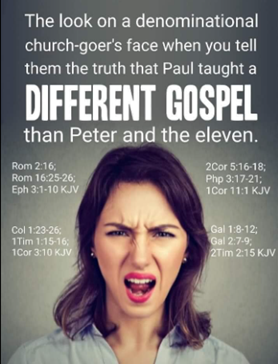
Once again, the claim that Paul taught a different gospel than Peter and other 11 apostles. It’s true. I saw a mem in a Facebook group that not only made the announcement, it provided a long list of passages from the Bible! Here’s the meme:

image

DID Paul preach a “different” gospel than Peter and the other 11 apostles? No fewer than twelve passages of scripture are offered to ‘prove’ that he did. In order to find out if any of those passages actually ‘prove’ the different gospel claim, I copy/pasted all of them into a new document in order to try and find out why they were given as proof texts. Here are the results of my labor:

1. Paul used the term “my gospel” in Rom 2:16 and Rom 16:25-26. Paul was in no way claiming that he ‘owned’ or had a special, unique, or different gospel, but was simply referring to the gospel that he was commissioned to preach.

2. Paul connected himself to the gospel by using terms like “the gospel you heard/received (from me); “the gospel we preached” (Paul and his ministry team); “I (Paul) was made a minister of the gospel. There is no mention whatsoever of the gospel Paul preached being different than the gospel preached by Peter and the 11.

3. Paul mentioned “Gentiles” four times in the ‘proof’ texts. He called Gentiles “fellowheirs” (with Israel) in Eph 3:6 and stated that he was given the primary mission of ministering the gospel to the gentiles three times in the ‘proof’ texts; Eph 3:1 and 3:8, and in Gal 2:8:

Eph 3:6  That the Gentiles should be fellowheirs, and of the same body, and partakers of his promise in Christ by the gospel:

Eph 3:1  For this cause I Paul, the prisoner of Jesus Christ for you Gentiles,

Eph 3:8  Unto me, who am less than the least of all saints, is this grace given, that I should preach among the Gentiles the unsearchable riches of Christ

Gal 2:8  (For he that wrought effectually in Peter to the apostleship of the circumcision, the same was mighty in me toward the Gentiles:

In that entire list of ‘proof’ texts, there is only one passage that talks about the gospel taught by Paul (and his team), as well as the gospel taught by Peter and the 11:

Gal 2:7-10 “But contrariwise, when they saw that the gospel of the uncircumcision was committed unto me, as the gospel of the circumcision was unto Peter; 8(For he that wrought effectually in Peter to the apostleship of the circumcision, the same was mighty in me toward the Gentiles:) 9And when James, Cephas, and John, who seemed to be pillars, perceived the grace that was given unto me, they gave to me and Barnabas the right hands of fellowship; that we should go unto the heathen, and they unto the circumcision. 10Only they would that we should remember the poor; the same which I also was forward to do.”

Not only is there no explicit indication that there were two separate and different gospels (for the circumcised and the uncircumcised), the opposite is true. That’s not just my personal opinion. I consulted no less than seven notable commentaries and all of them agree that while Peter and the 11 were to teach the gospel primarily to a Jewish audience, Paul’s mission was to teach the same gospel primarily to Gentiles (non-Jews). Here are two examples:

“The elder Apostles recognised St. Paul because they saw that his teaching was fundamentally the same as their own. At the same time, the success of St. Paul among the Gentiles proved that his mission to them had the divine sanction, just as the success of St. Peter among the Jews specially marked him out as the “Apostle of the circumcision.” – Ellicott

The gospel of the uncircumcision – The duty of preaching the gospel to the uncircumcised part of the world; that is, to the Gentiles Paul had received this as his unique office when he was converted and called to the ministry (see Acts 9:15; Acts 22:21); and they now perceived that he had been specially intrusted with this office, from the remarkable success which had attended his labors. It is evidently not meant here that Paul was to preach only to the Gentiles and Peter only to the Jews, for Paul often preached in the synagogues of the Jews, and Peter was the first who preached to a Gentile Acts 10; but it is meant that it was the main business of Paul to preach to the Gentiles, or that this was especially entrusted to him.

As the gospel of the circumcision – As the office of preaching the gospel to the Jews.

Was unto Peter – Peter was to preach principally to the circumcised Jews. It is evident that until this time Peter had been principally employed in preaching to the Jews. Paul selects Peter here particularly, doubtless because he was the oldest of the apostles, and in order to show that he was himself regarded as on a level in regard to the apostleship with the most aged and venerable of those who had been called to the apostolic office by the personal ministry of the Lord Jesus.” Barnes

Conclusion? There has always been and will always be ONE gospel. Peter and the 11 had as their primary audience Jews while Paul had as his primary audience non-Jews (Gentiles). Period.

For an old guy like me, that conclusion should be clear to a the average High School English student, assuming they still teach reading comprehension in HS. So why the constant false claim in some circles of professing Christianity?

The answer to that question, in mu my mind anyway, is that we believe what we want to believe. You see, the ‘different’ gospel claim was the product of a form of  Dispensationalism developed in the 19th century that took the took the separation of Israel and the New Testament church taught by some Dispensationalists to illogical extremes. But that’s another story.

How can we respond to the above erroneous claims? Well, like i did for this one, we can examine ‘proof’ texts to see if they actually contain the advertised ‘proof’. We don’t do so with an eye to ‘attack’ the offered proof, but only to examine and perhaps explain the results of our labors, as I have done with this blog. I also offered the results of published here in the FB post containing the meme shown above. Perhaps it will be profitable for readers, but perhaps not.

While I realize that sometimes we need to just walk away from some posts on social media, there are times when someone just might pay attention and grow in their faith walk. All of that’s a personal decision.

BE BLESSED!

Welcome to Babylon!

image

Perhaps one of the most important questions for believers today is this:

“How should Christians relate to this new world where they have lost a home-field advantage and are increasingly marginalized in popular culture?”[i]

This article’s title, Welcome to Babylon! Is also the title of Chapter 1 in Erwin Lutzer’s 2018 book The Church in Babylon. Dr. Lutzer’s chief concern in writing the book was what he termed the death of Christian America:

“What concerns me is the death of Christian America. Many of the biblical values upon which America was founded are no longer being allowed to shape our laws or our lives. In some lesser ways, Christians can identify with the Jews in Babylon. Our culture is instead being shaped by religious fragmentation, widespread disaffection with the church, changing sexual attitudes, and moral and spiritual relativism. Add to that “political correctness” and the “religion” of our political parties run amok, and it’s no wonder America—in the eyes of Christians—looks different each day.”[ii]

What was true in 2018 is perhaps even truer today, in 2024. What Dr. Lutzer described in general terms has various acronyms that have become institutionalized as almost ‘sacred’ in today’s society and culture, and at the same time violates clear Biblical teaching concerning how we as Christians ought to live as salt and light in a dark world. So without getting into the shameful details of we see all around us every day, what can we, as Christians do? How are we to respond to today’s world? Dr. Lutzer suggests that there are at least three ways we could respond, one of which is our only choice:

(1) assimilate the secular culture,

(2) isolate from the secular culture, or

(3) engage the secular culture.

In light of the gospel, the only choice for the Christ follower is to engage.”[iii]

Cultural assimilation would mean the church adopting cultural norms from the world in order to appeal to the world we want to reach. To isolate from the culture in which we live would require separating completely from the world we are trying to reach with the light of the gospel of Christ. The remaining option is to engage the culture, leaving us with the question; “What does it mean to engage the culture?”

To answer that question, we need only examine the instructions God gave, through His prophet Jeremiah, to the Israelites living in Babylonian captivity:

“These are the words of the letter that Jeremiah the prophet sent from Jerusalem to the surviving elders of the exiles, and to the priests, the prophets, and all the people, whom Nebuchadnezzar had taken into exile from Jerusalem to Babylon. 2 This was after King Jeconiah and the queen mother, the eunuchs, the officials of Judah and Jerusalem, the craftsmen, and the metal workers had departed from Jerusalem. 3 The letter was sent by the hand of Elasah the son of Shaphan and Gemariah the son of Hilkiah, whom Zedekiah king of Judah sent to Babylon to Nebuchadnezzar king of Babylon. It said: 4 “Thus says the Lord of hosts, the God of Israel, to all the exiles whom I have sent into exile from Jerusalem to Babylon: 5 Build houses and live in them; plant gardens and eat their produce. 6 Take wives and have sons and daughters; take wives for your sons, and give your daughters in marriage, that they may bear sons and daughters; multiply there, and do not decrease. 7 But seek the welfare of the city where I have sent you into exile, and pray to the Lord on its behalf, for in its welfare you will find your welfare. 8 For thus says the Lord of hosts, the God of Israel: Do not let your prophets and your diviners who are among you deceive you, and do not listen to the dreams that they dream, 9 for it is a lie that they are prophesying to you in my name; I did not send them, declares the Lord.” (Jeremiah 29:1-9, ESV)

After those instructions, is the promise with we are very familiar, and we often claim as our own:

10 “For thus says the Lord: When seventy years are completed for Babylon, I will visit you, and I will fulfill to you my promise and bring you back to this place. 11 For I know the plans I have for you, declares the Lord, plans for welfare and not for evil, to give you a future and a hope. (vv. 10-11)

Do the instructions given to the Israelite captives in Babylon pertain to Christians today? What is God telling Christians who are living as strangers in a strange land today? (1 Peter 2:11-12)

Once again Dr. Lutzer offers us a suggestion:

Let us read every word of this challenge from George MacLeod, a twentieth-century Scottish clergyman, who reminds us where the cross of Christ should be planted. We can’t change the world from a distance: “I simply argue that the Cross be raised again at the centre of the market-place as well as on the steeple of the church. I am recovering the claim that Jesus was not crucified in a cathedral between two candles, but on a cross between two thieves; on the town garbage-heap; at a crossroad so cosmopolitan that they had to write his title in Hebrew and in Latin and in Greek … at the kind of place where cynics talk smut, and thieves curse, and soldiers gamble. Because that is where churchmen should be and what churchmanship should be about.”[iv]

As Christians, we are called to be lights in the darkness:

“Though outnumbered and experiencing the humiliation of being marginalized in our culture, the church is still sent into the world to represent Christ. We are still the best witnesses of hope this hapless planet has! We, as the church, will never be effective unless we see ourselves as sent by Christ into the world. He prayed, “As you [the Father] sent me into the world, so I have sent them into the world” (John 17: 18). We are pilgrims, out of step with the ever-changing culture—yet we are sent by Christ, the Head of the church. The church is the last barrier between the present moral breakdown and total chaos.”[v]

A final question. If the church is the last barrier between the present moral breakdown and total chaos, how do we shine as lights in the darkness and make a difference for the Kingdom of light? Two ways come immediately to mind as starting points.

First, just at the Israelites were commanded to do in 6th century Babylon, we are to live normal lives in today’s Babylon, but not in service to the gods of this world. We are to seek to glorify God in all that we do. (Matthew 5:16)

Secondly, we must be prepared to share with others the hope that we have in Jesus Christ:

“But in your hearts honor Christ the Lord as holy, always being prepared to make a defense to anyone who asks you for a reason for the hope that is in you; yet do it with gentleness and respect, having a good conscience, so that, when you are slandered, those who revile your good behavior in Christ may be put to shame. (1 Peter 3:15-16, ESV).


[i] The Church in Babylon: Heeding the Call to Be a Light in the Darkness by Erwin W. Lutzer. p 11.

[ii] Ibid, p 52

[iii] Ibid, p 12

[iv] Ibid, p 73-74

[v] Ibid, p 58

__________________________

Dr. Erwin W. Lutzer (born October 3, 1941) is an evangelical Christian speaker, radio broadcaster, and author. He is the pastor emeritus of The Moody Church in Chicago, Illinois. His book The Church in Babylon: Heeding the Call to Be a Light in the Darkness can be obtained from Amazon.com , as well as from other Christian book outlets.

Glimpsing the Gospel in Every Book of the Bible

image

Biblical literacy is ever important for Christians as we seek to understand how the Scriptures come together to tell the story of the gospel.

This is the one of a series of short summaries of books of the Bible (Genesis and Exodus to) to help place their content into the larger story of the Bible as a whole.

Genesis

Many readers miss the forest of God’s larger purposes when immersed in the trees of each individual story. In creation, God creates humanity in his own image as his representatives to fill and rule the earth on his behalf (Gen. 1:26–28). Even after Adam and Eve sin and are punished, the promise is given that the offspring of the woman will defeat the serpent and restore the earth (Gen. 3:15). This promise is traced throughout the book in its genealogies,3 which provide the backbone of the entire book. Key divisions are traced by “These are the generations of,” tracing out the stories of key figures, starting with “the heavens and the earth” (2:4–4:26), and going on to Adam (5:1–6:8), Noah (6:9–9:29), the sons of Noah (10:1–11:19), Shem (11:10–26), Terah (11:27–25:11), Ishmael (25:12–18), Isaac (25:19–35:29), Esau (36:1–37:1), and Jacob (37:2–50:26). The line of God’s blessing is emphasized (e.g., Adam, Noah, Terah, Isaac, Jacob), while the stories of other lines receive less attention (e.g., Ishmael, Esau). The individual stories of Abraham, Jacob and Joseph are illustrations of how the promise of Genesis 3:15 begins to be fulfilled.

God desires to bless the nations through a future king. Adam is portrayed in the image of God, a phrase probably signifying a royal representative of God. Abraham would become a “great nation” (Gen. 12:2), and “kings shall come from you” (Gen. 17:6). God’s original command to “Be fruitful and multiply and fill the earth” (Gen. 1:28) is fulfilled in microcosm4 as “Israel settled in the land of Egypt . . . and were fruitful and multiplied greatly” (Gen. 47:27; cf. 1:28).

Israel fails, however, in its calling to be a “kingdom of priests” (Ex. 19:6). This priesthood is ultimately fulfilled through the church in Jesus Christ as a “royal priesthood” of all nations (1 Pet. 2:9). Through this priesthood, God’s purposes for creation as detailed in Genesis 1–2 are finally accomplished, as is seen in Revelation 21–22.

Exodus

Whereas Genesis records God’s promise that Abraham would become a great nation (Gen. 12:2), Exodus describes the fulfillment of that promise (Ex. 1:6– 7). Moreover, God’s covenant with the patriarchs,3 in which he promised to give their descendants the land of Canaan (Gen. 15:18; 26:3; 35:12), is the reason God delivers Israel from Egypt (Ex. 2:24).

Although God gives Israel the law and comes to dwell in their midst, ultimately Israel will not be faithful to their covenant with him. Only in Jesus do we find a faithful Israelite who keeps God’s law while simultaneously embodying God’s presence with his people (John 1:14).

_____________________________________

Taken from Glimpsing the Gospel in Every Book of the Bible by Crossway ©, October 19, 2018. Used by permission of Crossway, a publishing ministry of Good News Publishers, Wheaton, IL 60187, www.crossway.org.

Here’s a link the the Crossway .org site that lets you browse through the same short summary for every book of the Bible: Glimpsing the Gospel in Every Book of the Bible | Crossway Articles

BE BLESSED!

Does God Hate Sinners?

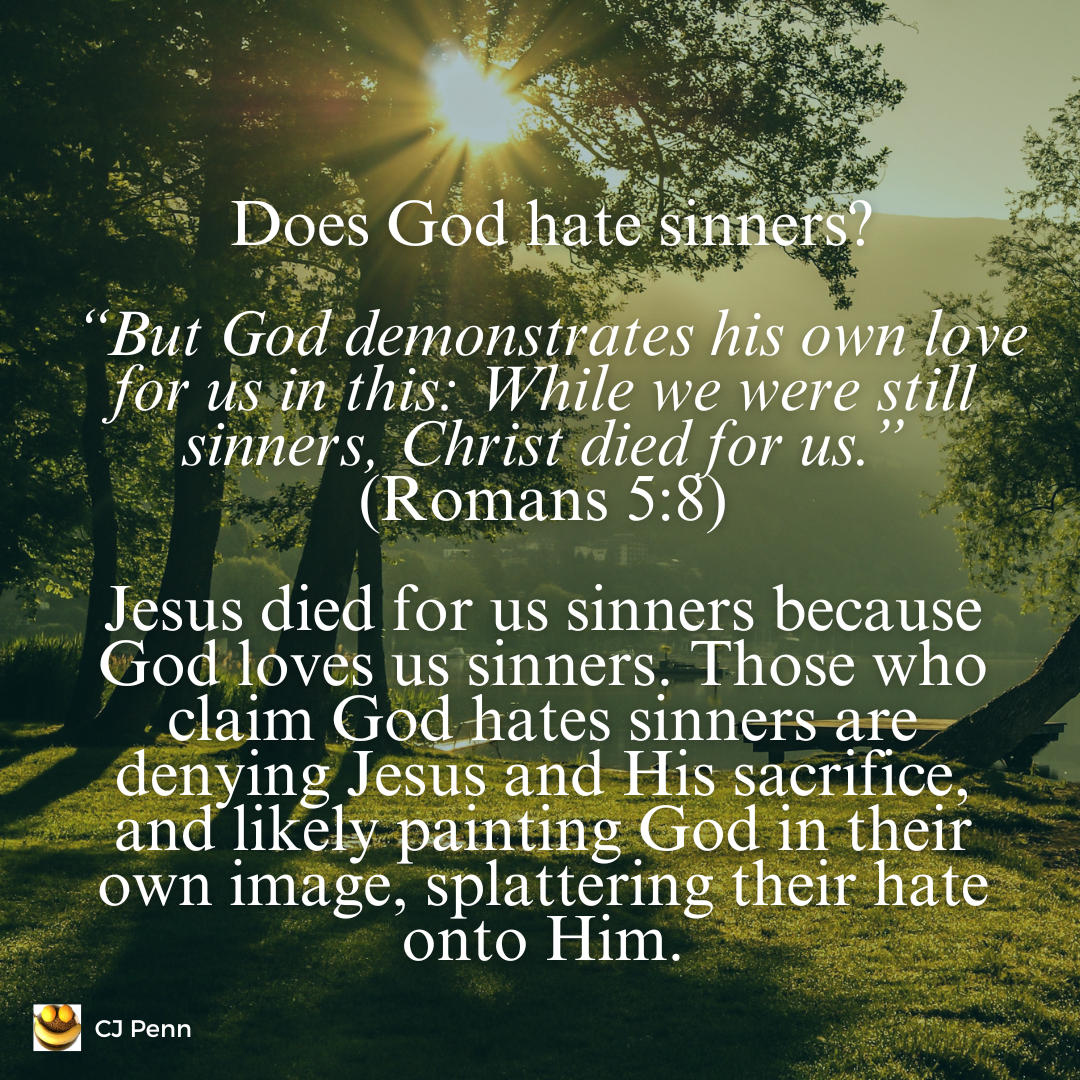
Does God hate sinners

That’s a meme I found in a Facebook Group recently that caused me to reconsider God’s love, as well as God’s hate. We love to dwell on God’s love, and rightly so! We don’t often dwell on what God hates. We are told to “Love the sinner but hate the sin.”, although it’s not actually a verse found in the Bible. I was curious about the comment, “Those who claim God hates sinners are denying Jesus and His sacrifice, and likely painting God in their own image and splattering their hate onto Him.” (Psychologists call that ‘projection’- the process of displacing one’s feelings onto a different person, animal, or object.)

So, wanting to find out more about what the author had in mind, I replied very simply, “Proverbs 6:16-19?”

Proverbs 6:16-19:

16These six things the Lord hates,
Yes, seven are an abomination to Him:
17 A proud look, A lying tongue,
Hands that shed innocent blood,
18 A heart that devises wicked plans,
Feet that are swift in running to evil,
19 A false witness who speaks lies,
And one who sows discord among brethren.

I received as a response: “Please also consider Luke 6:27-28. Would Jesus expect us to love our enemies, yet not love His own enemies, (e.g., sinners)?” That was an honest reply, although it didn’t address the Proverbs passage that indicates that God does in fact hate some people.

Luke 6:27-28

27 “But I say to you who hear: Love your enemies, do good to those who hate you, 28 bless those who curse you, and pray for those who spitefully use you.

We are told that there are things that God hates in the Proverbs passage and how we are to treat our enemies in the Luke passage. These are different contexts.

“It might seem a contradiction that a God who is love can also hate. Yet that’s exactly what Bible says is true: God is love (1 John 4:8), and God hates (Hosea 9:15). God’s nature is love—He always does what is best for others—and He hates what is contrary to His nature—He hates what is contrary to love.”[i]

Psalm 5:4-6 tells us specifically that God hates wickedness and individuals:

4For You are not a God who takes pleasure in wickedness,
Nor shall evil dwell with You.
5 The boastful shall not stand in Your sight;
You hate all workers of iniquity.
6 You shall destroy those who speak falsehood;
The Lord abhors the bloodthirsty and deceitful man.

Is there some kind of contradiction there? No. Scripture never contradicts itself.

What should we do with all of this? Well, God is God and cannot do evil. If that’s true, God’s hatred for whatever or whomever He hates is pure and just at the same time.

In the Romans 5 passage, Paul is telling ‘believers’ in Rome that while “we” were yet sinners Christ died for us. What does that mean? We are all born in rebellion against and enemies of God (Rom 8:7-8) Does it point to what the Bible calls the “elect” of God? Those who were “ordained to eternal life” (Acts 13:48). Does God love His “elect” (chosen before the foundation of the world for salvation (Eph 1:4 & 2 Thess 2:13) with a special love that is different than His love for the rest of His creation?

These are just questions that I have wrestled with and am still working on. What do I KNOW? That I am not God. That I am to love my enemies for the sake of Christ, whose sole mission was to come to this earth to “save His people from their sins” (Matt 1:21).

I KNOW that in sharing the gospel with the world around me, I’m to be like the farmer who plants seed and then goes to bed, to rise again the next day and plant more seed, not knowing exactly how it grows (Mark 4:26-29. I am to share the gospel to God opened hearts (Acts 16) and trust Him to save those whose hearts he opened to ‘hear the gospel’. So I pray often for God to open hearts to ‘Hear’ the message and thank Him that I have the great privilege of sharing that message.

BE BLESSED!


[i] Does God hate? If God is love, how can He hate? | GotQuestions.org

It’s the Economy, Stupid!

We’ve all heard that one so many times, it probably seems a bit trite. It’s a phrase that was coined by James Carville in 1992, when he was a campaign strategist for Bill Clinton. His phrase was directed at the campaign’s workers and intended as one of three messages for them to focus on. Well, it seems like it’s a main theme for the ongoing campaign for the next U.S. President, and by both sides, at that! And after all, making a decent living and being able to afford some of life’s little extras while putting away something for the future is a huge concern for most, if not all Americans, especially for Ed and Norma Normally!

Before I get too far down this rabbit trail, let’s get to the point. How many of you ever been involved in a discussion about a passage of Scripture or particular topic in which your frustration level has risen to the point of wanting to scream “It’s in the text, stupid! I can’t lie. I have, and it’s not a demonstration of proper Christian behavior.

That brings me to the real topic of this article, the clarity of Scripture. There’s even a great theological term for it; “perspicuity”, meaning clarity or understandability. If we are talking about the text of Scripture we’re not just talking about a single passage or paragraph, but we are also talking about spiritual principles, and especially those that seem to say one thing in one place in the Bible, and something different in other places. Let’s get to it!

THE CLARITY OF SCRIPTURE

This principle tells us to let the Bible speak for itself. We should allow Scripture to interpret Scripture, since it is its own best interpreter and commentator. Move from the known to the unknown by interpreting unclear passages in the light of those which are clear. When wrestling with a difficult passage or seemingly contradictory passages consult other verses which deal with the same topic. Now that might seem simple in theory, but it’s always good to have some examples. We’ll look at just one example, having to do with a topic near and dear to our hearts, salvation.

1. Are we saved and justified by faith alone, or by faith plus works? Most, if not all of you are thinking “That’s easy, we are saved by faith!” You even have passages from the Bible already tucked away in your memory, waiting to be called upon at a moment’s notice. You’re standing at home plate, batting cleanup in the lineup, smiling at the opposing pitcher!

Then, either while reading your own Bible during your private time, or during a conversation with others, you come face to face with the following passages (NKJV):

“Thus also faith by itself, if it does not have works, is dead.” (Jas 2:17)

“You see then that a man is justified by works, and not by faith only.” (Jas 2:24)

“For as the body without the spirit is dead, so faith without works is dead also. (Jas 2:26)

What do you do? How do you respond to that curveball? First, stay calm, no matter how adamantly that guy in the Facebook group presses his point. Calm down and politely share the passages stored away for just such a moment, and others, if you have them:

“For by grace you have been saved through faith, and that not of yourselves; it is the gift of God, not of works, lest anyone should boast.” (Eph 2:8-9)

“So they said, “Believe on the Lord Jesus Christ, and you will be saved, you and your household.” (Act 16:31)

“Therefore, we conclude that a man is justified by faith apart from the deeds of the law.” (Rom 3:28)

“For God so loved the world that He gave His only begotten Son, that whoever believes in Him should not perish but have everlasting life”. (Joh 3:16)

Your conversation partner will either stubbornly stick by his guns and say to you, “You didn’t read James?. It’s right there in the text!” Or he might claim that some of the passages you shared don’t have the word “alone” and that Martin Luther added the word alone to Rom 3:28 and therefore works are required for salvation, or he might realize that both sets of passages MUST be true, since God wrote the book (the goal). The authors of those passages (James, Paul, and Luke) were divinely inspired to write what they wrote. It’s either that or somebody’s lying.

That still leaves one question that needs to be answered. What does ‘justification’ in James 2:24 mean? This is where the fun begins. Let’s examine the context of James, chapter 2, beginning with verse 14:

 18But someone will say, “You have faith, and I have works.” Show me your faith without your works, and I will show you my faith by my works. 19You believe that there is one God. You do well. Even the demons believe—and tremble! 20But do you want to know, O foolish man, that faith without works is dead? 21Was not Abraham our father justified by works when he offered Isaac his son on the altar? 22Do you see that faith was working together with his works, and by works faith was made perfect? 23And the Scripture was fulfilled which says, ‘Abraham believed God, and it was accounted to him for righteousness.’ And he was called the friend of God. 24You see then that a man is justified by works, and not by faith only. 25Likewise, was not Rahab the harlot also justified by works when she received the messengers and sent them out another way? 26For as the body without the spirit is dead, so faith without works is dead also.”

In that section of James, chapter 2 is there a connection between ‘faith’ and ‘works’? Is this a “DUH!!” moment, or what? Look again at verses 15-17 again: 

15If a brother or sister is naked and destitute of daily food, 16and one of you says to them, “Depart in peace, be warmed and filled,” but you do not give them the things which are needed for the body, what does it profit? 17Thus also, faith by itself, if it does not have works, is dead.” (emphasis mine)

James is most likely writing to predominately Jewish Christians in house churches outside of Palestine[i]. He is telling them that if there is someone in need among them and they just send them off with a blessing and don’t meet their need, their professed faith is dead, tot, Muerte!

Now back to verse 14:

14What does it profit, my brethren, if someone says he has faith but does not have works? Can faith save him?”

What does this, along with the rest of this section of Scripture, tell us? Genuine, saving faith will always produce works. Conversely, ‘professed’ faith that doesn’t result in works was dead in the water to begin with. The justification spoken of in James, chapter 2 is justification before our fellow men.

I know that was a bit lengthy, but those two bits of Scripture, while presenting what looks like a clear contradiction is one of the best demonstrations of the letting Scripture interpret Scripture that I know of.

So what about those “James Carvill” moments? They are opportunities for stepping back, taking a deep breath, and becoming more Christlike in our communication skills!

image

BE BLESSED!


[i] Introduction to James (blueletterbible.org)

Does God (Really) Desire All to Be Saved?

Article by Tony Reinke, Senior writer, desiringGod.org

On the extent of who will be saved, the Bible makes two clear points:

  1. God desires that all sinners be saved (1 Timothy 2:4; 2 Peter 3:9; Ezekiel 18:23; Matthew 23:37).
  2. God chose some people from eternity past (the elect), to be saved unconditionally, and only those elect will genuinely respond to the gospel and be saved (Matthew 22:14; John 6:37, 44, 65; 8:47; 10:26–29; Romans 8:29–30; 9:6–23; 11:5–10; 1 Corinthians 1:26–30; Ephesians 1:4–5; 1 Thessalonians 1:4; 2 Thessalonians 2:13; James 2:5).

But how these two biblical truths (that seem to contradict) actually relate, has perplexed theologians and inquiring Christian minds for many centuries, sparking vigorous debates and (more recently) fiery comment threads on Facebook.

This pair of doctrines force questions like:

    • Can God genuinely will that all be saved (1), and yet only choose to save only some, the elect (2)?
    • Is it even logical to hold that God can at the same time will salvation for all (1), and not will salvation for all (2)?
    • If (1) and (2) are true, is God schizophrenic or confused? (1 Corinthians 14:33)
    • Or can a sovereign, all-powerful God who does whatever he pleases, hold wishful desires for the salvation of all that he cannot fulfill?
    • Which leads to asking, is there a power in the universe greater than God, frustrating his desires?
    • Or can God will in different ways simultaneously?
    • Or should modern Christians simply downplay election in order to highlight God’s desire for the salvation of all?
    • Because if we equally hold to election, isn’t our general offer of the gospel to all sinners disingenuous?
    • And won’t election erode the energy and incentive for global missions and evangelism that we derive from God’s desire for all to be saved?
    • And how does the ultimate aim of God’s own glory factor into this discussion?

These are just a few of the thick questions involved.

Finding the answers is like climbing Mount Everest. Not everyone is up for the climb, but we believe it can be done, and there are guides to help if you want to make the attempt. John Piper offers himself as a Sherpa of sorts for the steep climb in his new little book, Does God Desire All to Be Saved?

If you’re asking these types of questions — and if you’re up for the climb — the 50-page book is available as a free download here, or purchase here.

Tony Reinke (@tonyreinke) is a senior teacher for Desiring God, host of the Ask Pastor John podcast, and author of Ask Pastor John: 750 Bible Answers to Life’s Most Important Questions (2024). He lives in the Phoenix area with his wife and three children.

They Shall Inherit the Earth

Robert Eyton

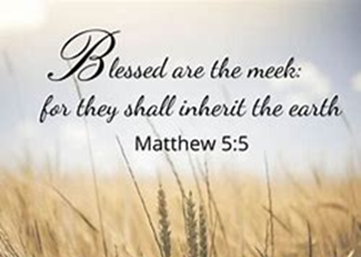
“Blessed are the meek, for they shall inherit the earth.”—ST MATTHEW 5:5.

The word which is translated meek has acquired for itself a meaning which is, to say the least, unfortunate. A meek man means to many people a tame man, one easily imposed upon. A meek person, from their point of view, is a person who has not much energy, is generally deficient in spirit, and consequently carries the burdens of the family. We count such persons as perhaps useful, as almost on the same level with the camel or the donkey in the animal sphere of existence, useful to carry loads and to expect little in return; but we should hardly say that they were ever likely to inherit the earth, or indeed to inherit anything, except the burdens that their neighbors could manage to thrust on them.

But the meekness of this Beatitude is certainly not mere tameness of nature, mere insensibility, mere want of “go.” It is not the “natural product of a tasteless tree,” it is the Divine outgrowth of a strong natural stock. If we read it “Blessed are the gentle,” we get a better idea of its meaning, only there again the gentleness is that which comes not from want of force, but from a strong and tranquil self-control. Meekness is the result of self-conquest, not of want of fire. It is not a tame insipidity, it is not an amiable flaccid inutility; that is not meekness in the sense of the Beatitude: nor is it the soft, yielding disposition whose cry is, “anything for a quiet life,” that grows into this gentleness. Meekness is a virtue that comes of a strong stock, it must be the outgrowth of a nature that has felt, and felt strongly, and learnt to control its feelings, learnt that real strength lies not merely in the power of letting oneself go, but in the power of holding oneself in. It is from those experiences that the true meekness, the gentleness of the Beatitude is the outcome.

The characteristics of the virtue, whether we call it meekness or gentleness, are something of this kind:—

I. It is willing to bear without retaliation. It is strong enough not to hit back, and that not from contempt but from real self-mastery. It knows that, very often, an injury is not meant, that, e.g., people say cruel things out of an angry feeling, which they do not mean, or false things out of mere idleness. It knows that the temptation to pay them back in kind is an unworthy one; it is strong enough, great enough, not to take refuge in disdain, but to make allowances, to wait, to be silent, to hope that the time will come when the slanderer will answer himself; at any rate, it will not allow itself to add to strife.

So the great model of meekness, our Master and only Saviour, Jesus Christ, comes before us to-day,* meek, and riding on an ass. We understand at once the absence of empty self-assertion. He calls to us, “Learn of Me; for I am meek and lowly in heart,” and teaches thus the lesson of His own gentleness. But no one can study His character and not see that meekness and gentleness are the result of self-control. Strong severity broke forth at times when His soul was moved by the spectacle of those who, under the garb of religion, worked for their own ends. “Woe unto you, scribes and Pharisees, hypocrites, for ye pay tithe of mint and anise and cummin, and have omitted the weightier matters of the law,—judgment, mercy, and faith.” “Ye blind guides, which strain at a gnat, and swallow a camel. Woe unto you, scribes and Pharisees, hypocrites, for ye make clean the outside of the cup and of the platter, but within they are full of extortion and excess.” “Woe unto you, scribes and Pharisees, hypocrites, for ye are like unto whited sepulchers, which indeed appear beautiful outward, but are within full of dead men’s bones, and of all uncleanness.” “Woe unto you, scribes and Pharisees, hypocrites, because ye build the tombs of the prophets, and garnish the sepulchers of the righteous, and say, ‘If we had been in the days of our fathers, we would not have been partakers with them in the blood of the prophets.’ Wherefore, ye be witnesses unto yourselves that ye are the children of them which killed the prophets.” “Ye serpents, ye generation of vipers, how can ye escape the damnation of hell?” This is the language of ideal gentleness,—this withering sarcasm, this stern reprobation!

II. Another characteristic which also proves the claim of meekness to strength is its willingness to subordinate mere personal claims—I mean claims so far as they are merely personal and not official. For a man may be ever so meek, and yet rightly insist on the deference due to his office. We see, e.g., that a judge must act in this way; he may not give away from gentleness anything that belongs to his position. And everyone has his place and his duties, whose claims he cannot allow to be subordinated to his own preferences; he must fill his place and do his duties. So far the gentle man is as strong and firm as anyone.

Nay, he is all the more so because he is not agitated by those merely personal questions which so often obscure official dignity. He shews his strength by thinking nothing of them, ignoring them, putting them on one side; he shews his real dignity not by self-assertion, but by discharging his duty and filling his place. These things he must do, these he may not forego, even if they involve a state which seems like assertion of dignity, he must submit to it; for the service of God demands that he should not forego any of his duties, or of what belongs to them. But all mere personal questions, which weaken and confuse the real issues, he is strong enough, and brave enough, to put on one side. Moses was the meekest of men as far as mere personal questions were concerned, he put them aside at once, he would not look at them; but when Moses is exercising his God-appointed office as leader of his people there is no shrinking and no tameness about him. He gave away nothing that belonged to his duties, or pertained to the exercise of his prerogatives.

The meek man may then come into collision with others, because he does the duties committed to him by God, but the one thing he will not do is to project his own personality, or to cherish petty grievances, from an overbearing sense of his own claims. He is strong enough to ignore all that, strong enough to refuse to regard mere personal injury.

The gentleness, then, that is blessed is the gentleness that bears with provocation and controls irritation and refuses to resent personal injury, while at the same time it is strong and brave in the discharge of its duties. It can say “no,” and stick to it without losing its temper over the matter. It has the power to put on one side mere personal irritations, mere questions of offended dignity; it has the strength to control self, to put God’s cause before its own feeling, to act with the single eye; it presents that combination of firmness with gentleness which is so powerful, if so rare. And surely our own experience will tell us how strong and how blessed a thing is meekness of this kind. How often have we felt the withering power of our own irritability; how often have we grieved over the way in which our own impatience has spoiled our best work. “If only I hadn’t lost my temper,” we say, because we feel the weakness of it. Conversely have we not felt that the real good of our life has come, not from our shrewdness, nor from our power of brain, but out of our self-control? How often have we mourned over the lack of an influence which we felt we should have had if we had been more self-controlled! We feel, above all, in dealing with children the strength of meekness. There is a sovereignty that belongs to an iron will—we all own it and we all hate it: there is another sovereignty that belongs to insolent brutality or to mere violent temper, the sovereignty that creates a solitude, and calls that peace. We hate that still more, and get out of its way if we can. But there is a sovereignty, against which we do not rebel, that belongs to the loving compulsion of those who, having learnt to control themselves, are able to influence others by a word or a look, in a way which is only intelligible to those who can trace the secret of their power. Such power belongs to those into whose hearts something of Christ’s meekness has entered, of whom it may be said in truth, “His gentleness has made them great.” Wherein too lies the power of Christ? Surely in Him we see the strength of meekness, “the omnipotence of gentleness and the gentleness of omnipotence.” The gentle God comes and walks among men, and they are conscious of a force and a power within Him that no Cæsar had ever excited. “As soon as He said I am He, they went backward, and fell to the ground.” There was something in Him unapproached and unapproachable, the moral majesty of gentleness.

And this it is which is always justifying the apparent paradox which tells us that “the meek shall inherit the earth.”

Gentleness does win its way where violence only provokes hostility. Moral power is real power. No doubt for a time it may have to yield to brute force. It is no match immediately for bloodthirsty battalions; but all history and all experience prove that the victory of violence is short-lived and the triumph of gentleness is enduring. Even while gentleness is under the yoke it does not lose its sovereign attributes. None feel its essential enduring superiority more keenly than those who, for a time, overwhelm it by brute force. “It is John the Baptist whom I beheaded,” cries Herod. “Why does he plague me still?” So mere force pays involuntary homage to the moral majesty of the meek and gentle. And surely all our modern experience points in the same direction. The man who is self-controlled, who does not make enemies, who is true and straight, is the man who is felt in our modern life, and will be more felt as the democracy advances, as the power that once belonged to privilege and rank and to being “the son of your father” disappears. The days of the loud-mouthed pretenders are passing away; even fluency of speech is becoming less accepted as a sign of supreme virtue by us slow-speaking Saxons. We are coming to the days when the artificial distinctions of class will cease, when the moral methods of influence will alone have any weight, when “force” will be felt finally to be “no remedy,” and a high position will be only valued for the duties involved in it. It is here, I believe, that our great trial lies—the thing that sifts us. In the movement of men’s minds, much that was once taken for granted has at last become an open question. The thing which is asked is not, “Is it the correct thing to believe this?” but, “What is the moral effect of this or that belief?” “Are Christians showing the spirit of Christ? Do they care for His ideals?” Or have they let themselves fall into the temptation of using His Name and calling upon Him as their leader, while they use methods which He would never have endured? We cannot remember too often that it is by moral methods, and not by physical, nor even, except in a subordinate way, by intellectual, that the Kingdom of God is being set up. The real test of each man and woman who is called upon to act in any public fashion is whether he or she really believes in moral methods, believes in them enough to act on them, believes in them rather than in fraud or trickery or force. The effect of self-discipline, of the gentleness that comes from self-control, can never be really estimated here. We live in a fog; we cannot see clearly what is success and what is failure, nor can we see “the seed growing secretly;” we can only mark quick returns and big results. We live in a hurry. It is hard to collect ourselves for calmness and breadth of view and self-command. We need to remember that strong language does not always cover strong purpose, and that to possess the earth something more is needed than the showy and specious achievements of mere rhetoric. In quiet, unperceived places, in secret strivings after self-discipline, in wrestling with the devils of hasty temper and violent methods, gentleness is established within us, and wherever gentleness is established, thence flows power. How it wins its victories and where it reaches to we do not know; we know not how much we owe to the prayers of the meek.

No; where the upholding grace is won

We dare not ask, nor heaven would tell;

But sure from many a hidden dell,

From many a rural nook unthought of there,

Rises for that proud world the saint’s prevailing prayer.

Yes, the meek do inherit the earth. Let us no longer be deceived and act unconsciously in the belief that violence, brutality, and haste can effect anything lasting. Whatever these things seem to effect, let us be sure that self-control and meekness and gentleness have a power beyond all else. If we would help forward the kingdom of God, let us learn to resist our hasty impulses, to check our inward irritation, to command ourselves so that we may at least do something towards our great lifework, which is to spread the influence of Christ before “the night cometh, when no man can work.”

Eyton, R. (1896). The Benediction on the Meek. In The Beatitudes (Second Edition, pp. 44–53). Kegan Paul, Trench, Trübner & Co. Ltd. (Public Domain)

clip_image002

OnlineSource: They Shall Inherit the Earth (cmfhq.org)

The Vine

“I am the True Vine.”—JOHN 15:1.

ALL earthly things are the shadows of heavenly realities,—the expression, in created, visible forms, of the invisible glory of God. The Life and the Truth are in heaven; on earth we have figures and shadows of the heavenly truths. When Jesus says: I am the True Vine, He tells us that all the vines of earth are pictures and emblems of Himself. He is the Divine reality, of which they are the created expression. They all point to Him, and preach Him, and reveal Him. If you would know Jesus, study the vine.

How many eyes have gazed on and admired the great vine at Hampton Court, with its beautiful fruit. Come and gaze on the Heavenly Vine till your eye turns from all else to admire Him. How many, in a sunny clime, sit and rest under the shadow of their vine. Come and be still under the shadow of the True Vine, and rest under it from the heat of the day. What countless numbers rejoice in the fruit of the vine. Come, and take, and eat of the heavenly fruit of the True Vine, and let your soul say: I sat under His shadow with great delight, and His fruit was sweet to my taste.

I am the True Vine. This is a heavenly mystery. The earthly vine can teach you much about this Vine of Heaven. Many interesting and beautiful points of comparison suggest themselves, and help us to get conceptions of what Christ meant. But such thoughts do not teach us to know what the Heavenly Vine really is, in its cooling shade, and its lifegiving fruit. The experience of this is part of the hidden mystery, which none but Jesus Himself, by His Holy Spirit, can unfold and impart.

I am the True Vine. The vine is the Living Lord, who Himself speaks, and gives, and works all that He has for us. If you would know the meaning and power of that word, do not think to find it by thought or study; these may help to show you what you must get from Him, to awaken desire and hope and prayer, but they cannot show you the Vine. Jesus alone can reveal Himself. He gives His Holy Spirit to open the eyes to gaze upon Himself, to open the heart to receive Himself. He must Himself speak the word to you and me.

I am the True Vine. And what am I to do, if I want the mystery, in all its heavenly beauty and blessing, opened up to me? With what you already know of the parable, bow down and be still, worship and wait, until the Divine Word enters your heart, and you feel His Holy Presence with you, and in you. The overshadowing of His Holy Love will give you the perfect calm and rest of knowing that the Vine will do all.

I am the True Vine. He who speaks is God, in His infinite power able to enter into us. He is man, one with us. He is the Crucified One, who won a perfect righteousness and a Divine life for us through His death. He is the glorified One, who from the throne gives His Spirit to make His Presence real and true. He speaks—oh! listen, not to His words only, but to Himself, as He whispers secretly day by day: I AM THE TRUE VINE. All that the Vine can ever be to its branch, I WILL BE TO YOU.

Holy Lord Jesus! the Heavenly Vine of God’s own planting, I beseech Thee, reveal Thyself to my soul. Let the Holy Spirit, not in thought, but in experience, give me to know all that Thou, the Son of God, art to me as the True Vine.

Murray, A. (1898). The Mystery of the True Vine: Meditations for a Month (pp. 15–19). J. Nisbet & Co. (Public Domain)