
The ‘Different’ Gospels of Paul and Peter?

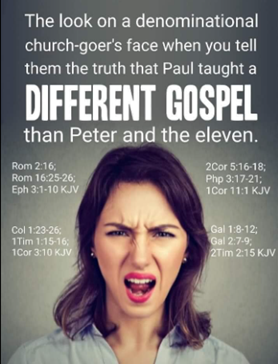
Once again, the claim that Paul taught a different gospel than Peter and other 11 apostles. It’s true. I saw a mem in a Facebook group that not only made the announcement, it provided a long list of passages from the Bible! Here’s the meme:
image

DID Paul preach a “different” gospel than Peter and the other 11 apostles? No fewer than twelve passages of scripture are offered to ‘prove’ that he did. In order to find out if any of those passages actually ‘prove’ the different gospel claim, I copy/pasted all of them into a new document in order to try and find out why they were given as proof texts. Here are the results of my labor:

1. Paul used the term “my gospel” in Rom 2:16 and Rom 16:25-26. Paul was in no way claiming that he ‘owned’ or had a special, unique, or different gospel, but was simply referring to the gospel that he was commissioned to preach.

2. Paul connected himself to the gospel by using terms like “the gospel you heard/received (from me); “the gospel we preached” (Paul and his ministry team); “I (Paul) was made a minister of the gospel. There is no mention whatsoever of the gospel Paul preached being different than the gospel preached by Peter and the 11.

3. Paul mentioned “Gentiles” four times in the ‘proof’ texts. He called Gentiles “fellowheirs” (with Israel) in Eph 3:6 and stated that he was given the primary mission of ministering the gospel to the gentiles three times in the ‘proof’ texts; Eph 3:1 and 3:8, and in Gal 2:8:

Eph 3:6  That the Gentiles should be fellowheirs, and of the same body, and partakers of his promise in Christ by the gospel:

Eph 3:1  For this cause I Paul, the prisoner of Jesus Christ for you Gentiles,

Eph 3:8  Unto me, who am less than the least of all saints, is this grace given, that I should preach among the Gentiles the unsearchable riches of Christ

Gal 2:8  (For he that wrought effectually in Peter to the apostleship of the circumcision, the same was mighty in me toward the Gentiles:

In that entire list of ‘proof’ texts, there is only one passage that talks about the gospel taught by Paul (and his team), as well as the gospel taught by Peter and the 11:

Gal 2:7-10 “But contrariwise, when they saw that the gospel of the uncircumcision was committed unto me, as the gospel of the circumcision was unto Peter; 8(For he that wrought effectually in Peter to the apostleship of the circumcision, the same was mighty in me toward the Gentiles:) 9And when James, Cephas, and John, who seemed to be pillars, perceived the grace that was given unto me, they gave to me and Barnabas the right hands of fellowship; that we should go unto the heathen, and they unto the circumcision. 10Only they would that we should remember the poor; the same which I also was forward to do.”

Not only is there no explicit indication that there were two separate and different gospels (for the circumcised and the uncircumcised), the opposite is true. That’s not just my personal opinion. I consulted no less than seven notable commentaries and all of them agree that while Peter and the 11 were to teach the gospel primarily to a Jewish audience, Paul’s mission was to teach the same gospel primarily to Gentiles (non-Jews). Here are two examples:

“The elder Apostles recognised St. Paul because they saw that his teaching was fundamentally the same as their own. At the same time, the success of St. Paul among the Gentiles proved that his mission to them had the divine sanction, just as the success of St. Peter among the Jews specially marked him out as the “Apostle of the circumcision.” – Ellicott

The gospel of the uncircumcision – The duty of preaching the gospel to the uncircumcised part of the world; that is, to the Gentiles Paul had received this as his unique office when he was converted and called to the ministry (see Acts 9:15; Acts 22:21); and they now perceived that he had been specially intrusted with this office, from the remarkable success which had attended his labors. It is evidently not meant here that Paul was to preach only to the Gentiles and Peter only to the Jews, for Paul often preached in the synagogues of the Jews, and Peter was the first who preached to a Gentile Acts 10; but it is meant that it was the main business of Paul to preach to the Gentiles, or that this was especially entrusted to him.

As the gospel of the circumcision – As the office of preaching the gospel to the Jews.

Was unto Peter – Peter was to preach principally to the circumcised Jews. It is evident that until this time Peter had been principally employed in preaching to the Jews. Paul selects Peter here particularly, doubtless because he was the oldest of the apostles, and in order to show that he was himself regarded as on a level in regard to the apostleship with the most aged and venerable of those who had been called to the apostolic office by the personal ministry of the Lord Jesus.” Barnes

Conclusion? There has always been and will always be ONE gospel. Peter and the 11 had as their primary audience Jews while Paul had as his primary audience non-Jews (Gentiles). Period.

For an old guy like me, that conclusion should be clear to a the average High School English student, assuming they still teach reading comprehension in HS. So why the constant false claim in some circles of professing Christianity?

The answer to that question, in mu my mind anyway, is that we believe what we want to believe. You see, the ‘different’ gospel claim was the product of a form of  Dispensationalism developed in the 19th century that took the took the separation of Israel and the New Testament church taught by some Dispensationalists to illogical extremes. But that’s another story.

How can we respond to the above erroneous claims? Well, like i did for this one, we can examine ‘proof’ texts to see if they actually contain the advertised ‘proof’. We don’t do so with an eye to ‘attack’ the offered proof, but only to examine and perhaps explain the results of our labors, as I have done with this blog. I also offered the results of published here in the FB post containing the meme shown above. Perhaps it will be profitable for readers, but perhaps not.

While I realize that sometimes we need to just walk away from some posts on social media, there are times when someone just might pay attention and grow in their faith walk. All of that’s a personal decision.

BE BLESSED!

Welcome to Babylon!

image

Perhaps one of the most important questions for believers today is this:

“How should Christians relate to this new world where they have lost a home-field advantage and are increasingly marginalized in popular culture?”[i]

This article’s title, Welcome to Babylon! Is also the title of Chapter 1 in Erwin Lutzer’s 2018 book The Church in Babylon. Dr. Lutzer’s chief concern in writing the book was what he termed the death of Christian America:

“What concerns me is the death of Christian America. Many of the biblical values upon which America was founded are no longer being allowed to shape our laws or our lives. In some lesser ways, Christians can identify with the Jews in Babylon. Our culture is instead being shaped by religious fragmentation, widespread disaffection with the church, changing sexual attitudes, and moral and spiritual relativism. Add to that “political correctness” and the “religion” of our political parties run amok, and it’s no wonder America—in the eyes of Christians—looks different each day.”[ii]

What was true in 2018 is perhaps even truer today, in 2024. What Dr. Lutzer described in general terms has various acronyms that have become institutionalized as almost ‘sacred’ in today’s society and culture, and at the same time violates clear Biblical teaching concerning how we as Christians ought to live as salt and light in a dark world. So without getting into the shameful details of we see all around us every day, what can we, as Christians do? How are we to respond to today’s world? Dr. Lutzer suggests that there are at least three ways we could respond, one of which is our only choice:

(1) assimilate the secular culture,

(2) isolate from the secular culture, or

(3) engage the secular culture.

In light of the gospel, the only choice for the Christ follower is to engage.”[iii]

Cultural assimilation would mean the church adopting cultural norms from the world in order to appeal to the world we want to reach. To isolate from the culture in which we live would require separating completely from the world we are trying to reach with the light of the gospel of Christ. The remaining option is to engage the culture, leaving us with the question; “What does it mean to engage the culture?”

To answer that question, we need only examine the instructions God gave, through His prophet Jeremiah, to the Israelites living in Babylonian captivity:

“These are the words of the letter that Jeremiah the prophet sent from Jerusalem to the surviving elders of the exiles, and to the priests, the prophets, and all the people, whom Nebuchadnezzar had taken into exile from Jerusalem to Babylon. 2 This was after King Jeconiah and the queen mother, the eunuchs, the officials of Judah and Jerusalem, the craftsmen, and the metal workers had departed from Jerusalem. 3 The letter was sent by the hand of Elasah the son of Shaphan and Gemariah the son of Hilkiah, whom Zedekiah king of Judah sent to Babylon to Nebuchadnezzar king of Babylon. It said: 4 “Thus says the Lord of hosts, the God of Israel, to all the exiles whom I have sent into exile from Jerusalem to Babylon: 5 Build houses and live in them; plant gardens and eat their produce. 6 Take wives and have sons and daughters; take wives for your sons, and give your daughters in marriage, that they may bear sons and daughters; multiply there, and do not decrease. 7 But seek the welfare of the city where I have sent you into exile, and pray to the Lord on its behalf, for in its welfare you will find your welfare. 8 For thus says the Lord of hosts, the God of Israel: Do not let your prophets and your diviners who are among you deceive you, and do not listen to the dreams that they dream, 9 for it is a lie that they are prophesying to you in my name; I did not send them, declares the Lord.” (Jeremiah 29:1-9, ESV)

After those instructions, is the promise with we are very familiar, and we often claim as our own:

10 “For thus says the Lord: When seventy years are completed for Babylon, I will visit you, and I will fulfill to you my promise and bring you back to this place. 11 For I know the plans I have for you, declares the Lord, plans for welfare and not for evil, to give you a future and a hope. (vv. 10-11)

Do the instructions given to the Israelite captives in Babylon pertain to Christians today? What is God telling Christians who are living as strangers in a strange land today? (1 Peter 2:11-12)

Once again Dr. Lutzer offers us a suggestion:

Let us read every word of this challenge from George MacLeod, a twentieth-century Scottish clergyman, who reminds us where the cross of Christ should be planted. We can’t change the world from a distance: “I simply argue that the Cross be raised again at the centre of the market-place as well as on the steeple of the church. I am recovering the claim that Jesus was not crucified in a cathedral between two candles, but on a cross between two thieves; on the town garbage-heap; at a crossroad so cosmopolitan that they had to write his title in Hebrew and in Latin and in Greek … at the kind of place where cynics talk smut, and thieves curse, and soldiers gamble. Because that is where churchmen should be and what churchmanship should be about.”[iv]

As Christians, we are called to be lights in the darkness:

“Though outnumbered and experiencing the humiliation of being marginalized in our culture, the church is still sent into the world to represent Christ. We are still the best witnesses of hope this hapless planet has! We, as the church, will never be effective unless we see ourselves as sent by Christ into the world. He prayed, “As you [the Father] sent me into the world, so I have sent them into the world” (John 17: 18). We are pilgrims, out of step with the ever-changing culture—yet we are sent by Christ, the Head of the church. The church is the last barrier between the present moral breakdown and total chaos.”[v]

A final question. If the church is the last barrier between the present moral breakdown and total chaos, how do we shine as lights in the darkness and make a difference for the Kingdom of light? Two ways come immediately to mind as starting points.

First, just at the Israelites were commanded to do in 6th century Babylon, we are to live normal lives in today’s Babylon, but not in service to the gods of this world. We are to seek to glorify God in all that we do. (Matthew 5:16)

Secondly, we must be prepared to share with others the hope that we have in Jesus Christ:

“But in your hearts honor Christ the Lord as holy, always being prepared to make a defense to anyone who asks you for a reason for the hope that is in you; yet do it with gentleness and respect, having a good conscience, so that, when you are slandered, those who revile your good behavior in Christ may be put to shame. (1 Peter 3:15-16, ESV).


[i] The Church in Babylon: Heeding the Call to Be a Light in the Darkness by Erwin W. Lutzer. p 11.

[ii] Ibid, p 52

[iii] Ibid, p 12

[iv] Ibid, p 73-74

[v] Ibid, p 58

__________________________

Dr. Erwin W. Lutzer (born October 3, 1941) is an evangelical Christian speaker, radio broadcaster, and author. He is the pastor emeritus of The Moody Church in Chicago, Illinois. His book The Church in Babylon: Heeding the Call to Be a Light in the Darkness can be obtained from Amazon.com , as well as from other Christian book outlets.

Glimpsing the Gospel in Every Book of the Bible

image

Biblical literacy is ever important for Christians as we seek to understand how the Scriptures come together to tell the story of the gospel.

This is the one of a series of short summaries of books of the Bible (Genesis and Exodus to) to help place their content into the larger story of the Bible as a whole.

Genesis

Many readers miss the forest of God’s larger purposes when immersed in the trees of each individual story. In creation, God creates humanity in his own image as his representatives to fill and rule the earth on his behalf (Gen. 1:26–28). Even after Adam and Eve sin and are punished, the promise is given that the offspring of the woman will defeat the serpent and restore the earth (Gen. 3:15). This promise is traced throughout the book in its genealogies,3 which provide the backbone of the entire book. Key divisions are traced by “These are the generations of,” tracing out the stories of key figures, starting with “the heavens and the earth” (2:4–4:26), and going on to Adam (5:1–6:8), Noah (6:9–9:29), the sons of Noah (10:1–11:19), Shem (11:10–26), Terah (11:27–25:11), Ishmael (25:12–18), Isaac (25:19–35:29), Esau (36:1–37:1), and Jacob (37:2–50:26). The line of God’s blessing is emphasized (e.g., Adam, Noah, Terah, Isaac, Jacob), while the stories of other lines receive less attention (e.g., Ishmael, Esau). The individual stories of Abraham, Jacob and Joseph are illustrations of how the promise of Genesis 3:15 begins to be fulfilled.

God desires to bless the nations through a future king. Adam is portrayed in the image of God, a phrase probably signifying a royal representative of God. Abraham would become a “great nation” (Gen. 12:2), and “kings shall come from you” (Gen. 17:6). God’s original command to “Be fruitful and multiply and fill the earth” (Gen. 1:28) is fulfilled in microcosm4 as “Israel settled in the land of Egypt . . . and were fruitful and multiplied greatly” (Gen. 47:27; cf. 1:28).

Israel fails, however, in its calling to be a “kingdom of priests” (Ex. 19:6). This priesthood is ultimately fulfilled through the church in Jesus Christ as a “royal priesthood” of all nations (1 Pet. 2:9). Through this priesthood, God’s purposes for creation as detailed in Genesis 1–2 are finally accomplished, as is seen in Revelation 21–22.

Exodus

Whereas Genesis records God’s promise that Abraham would become a great nation (Gen. 12:2), Exodus describes the fulfillment of that promise (Ex. 1:6– 7). Moreover, God’s covenant with the patriarchs,3 in which he promised to give their descendants the land of Canaan (Gen. 15:18; 26:3; 35:12), is the reason God delivers Israel from Egypt (Ex. 2:24).

Although God gives Israel the law and comes to dwell in their midst, ultimately Israel will not be faithful to their covenant with him. Only in Jesus do we find a faithful Israelite who keeps God’s law while simultaneously embodying God’s presence with his people (John 1:14).

_____________________________________

Taken from Glimpsing the Gospel in Every Book of the Bible by Crossway ©, October 19, 2018. Used by permission of Crossway, a publishing ministry of Good News Publishers, Wheaton, IL 60187, www.crossway.org.

Here’s a link the the Crossway .org site that lets you browse through the same short summary for every book of the Bible: Glimpsing the Gospel in Every Book of the Bible | Crossway Articles

BE BLESSED!